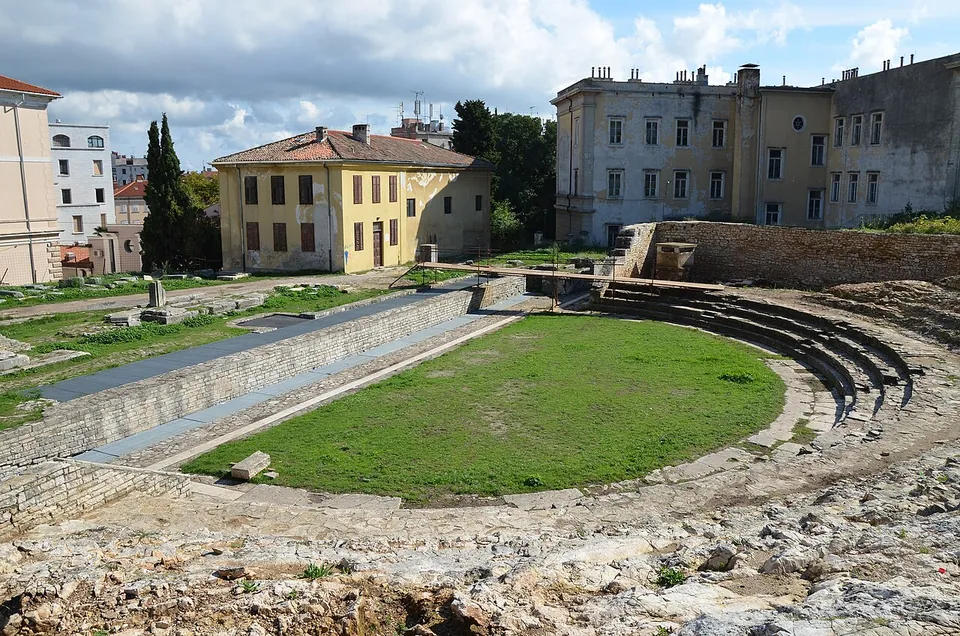
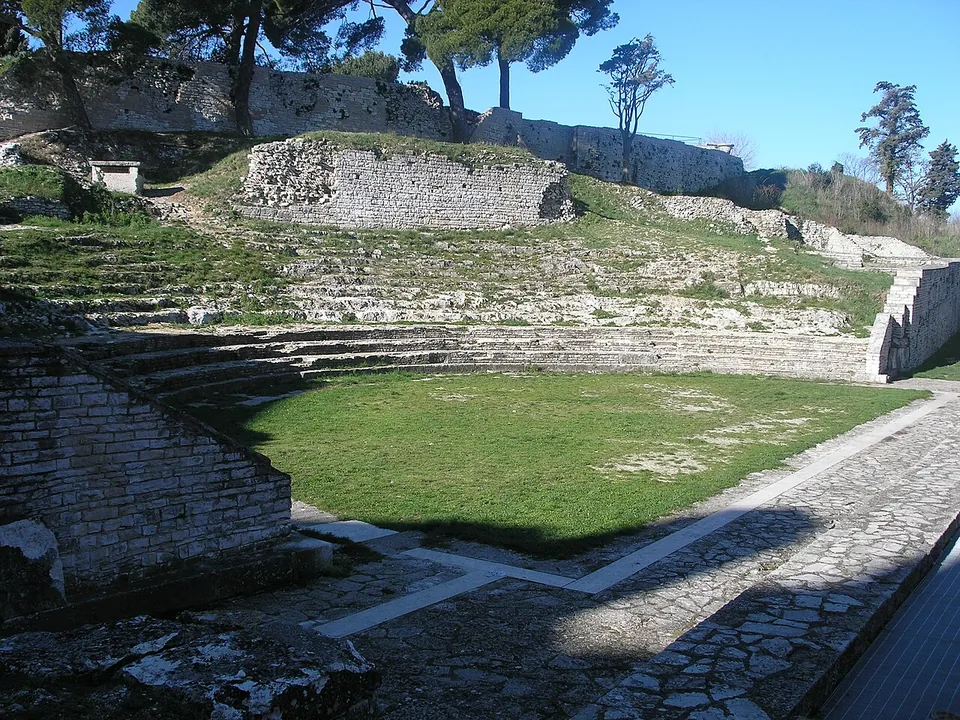
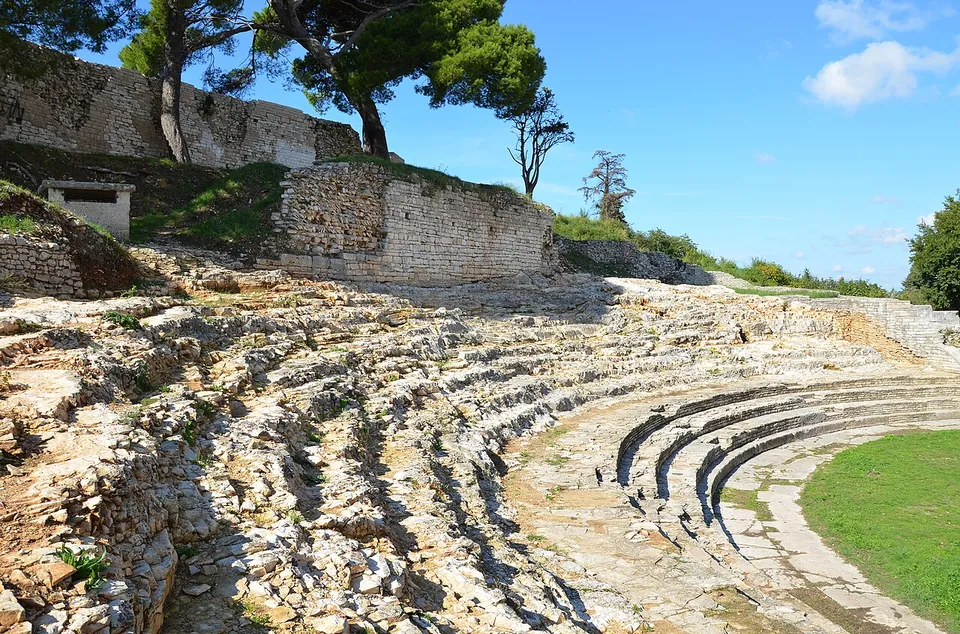
The Small Roman Theatre is one of the three buildings Roman Pula had for public entertainment, a semicircular theatre set into the eastern slope of the town’s central hill. Excavated and then partly rebuilt in 2021–2022, it is now used for performances again.
What is there today
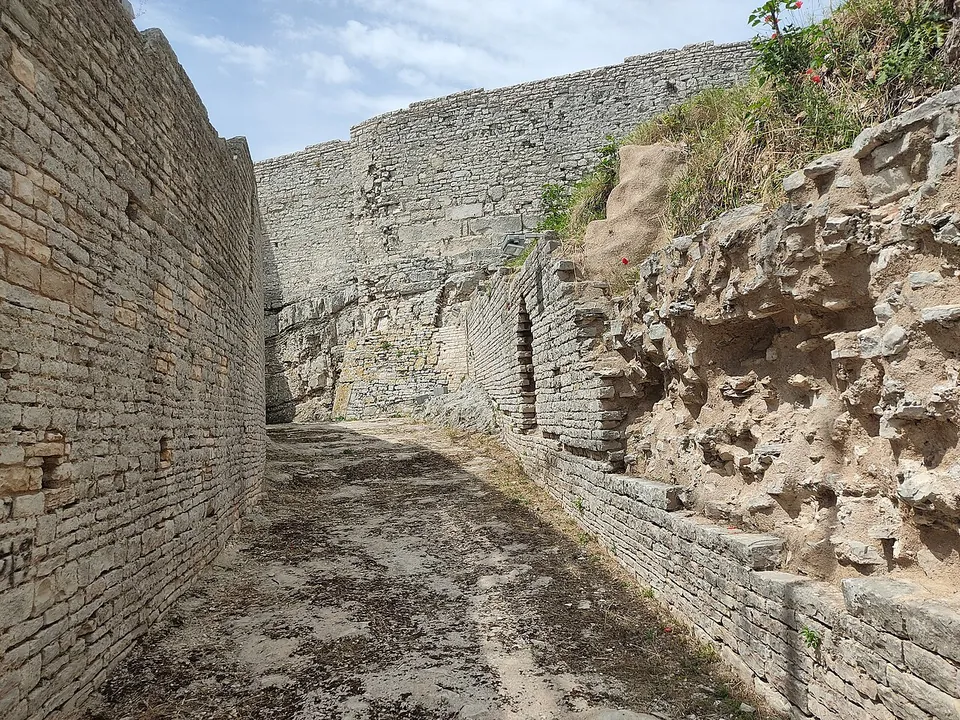
The foundations of the stage building and the semicircular auditorium, its seating partly cut into the living rock of the slope, with the stage and the actors’ area on the flat side (the museum; hr.wikipedia). The 2021–2022 works made it possible to see almost the full original height of the theatre and the layout of its seats (the museum). Built of local Istrian limestone, the theatre was once faced with marble low down and plastered and painted higher up, and its stage was richly decorated with pilasters, columns, architraves and arches; a few remains of the reliefs from the stage front are in the Archaeological Museum of Istria below, which is currently closed for a new permanent display (the museum; hr.wikipedia).
Is it worth the trip?
As part of a walk round Roman Pula, yes, if you can get in. It is a different kind of building from the Arena — a theatre for plays rather than an amphitheatre for games. The difficulty is access: there is no timetable, and visits are arranged by writing to the museum, so on a casual walk you may only see it from outside. Part of what stands is a modern rebuilding on the Roman plan.
Getting there
The theatre is at Herculov prolaz 1, on the eastern slope of the old town’s hill above the Archaeological Museum of Istria (the museum). The Twin Gates of the Roman walls lead up to it, as they did in antiquity (hr.wikipedia). Entry is free; to visit, write to the museum at arheoloski-muzej-istre@pu.t-com.hr (Archaeological Museum of Istria, read 26 September 2026).
Visiting details
- Opening hours
- No regular opening hours are published; to visit, write to the museum at arheoloski-muzej-istre@pu.t-com.hr. The theatre is used for performances and events.
- Tickets
- Free (Archaeological Museum of Istria).
Before you go
- Visits are arranged by email rather than on a timetable, so the gate may be shut when you pass.
Hours and prices checked 26 September 2026 on the operator's own site. Confirm before travelling.
History
Pula had two theatres. This one stood inside the town, on the eastern and north-eastern slopes of the central hill; the Large Roman Theatre stood outside the walls and was largely quarried in the 17th century by Antoine de Ville to build Pula’s castle (the museum; hr.wikipedia). Using a hillside for the auditorium was more a Greek than a Roman habit, hr.wikipedia notes. After it fell out of use the theatre was buried and forgotten until excavations at the end of the 19th and the beginning of the 20th century; only in 1911 did the archaeologist Anton Gnirs realise it was a theatre — its northern entrance had been taken for the approach to the Capitol (the museum). hr.wikipedia says it held up to 5,000 spectators in antiquity; rebuilt, it seats about 1,250.
More photographs
Nearby
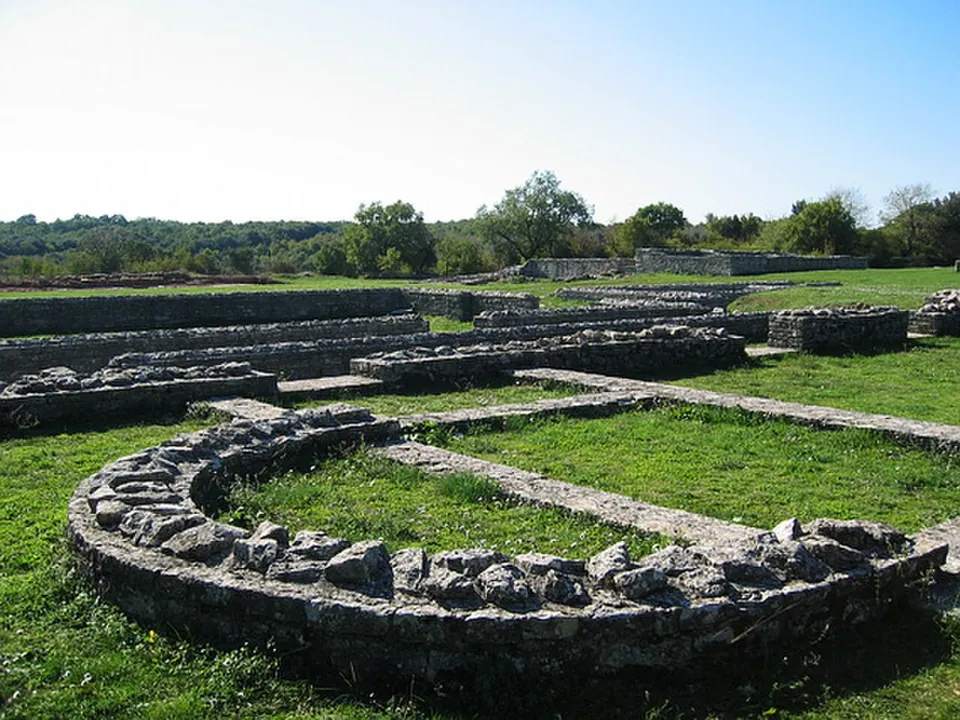
Photo: Hieronymushistriae · CC BY-SA 3.0 · Commons
44 km · city · Istria County
Parentium – Poreč
The town plan still shows the shape of the Roman castrum, and the two main streets, the Decumanus and the Cardo Maximus, keep their original lines.
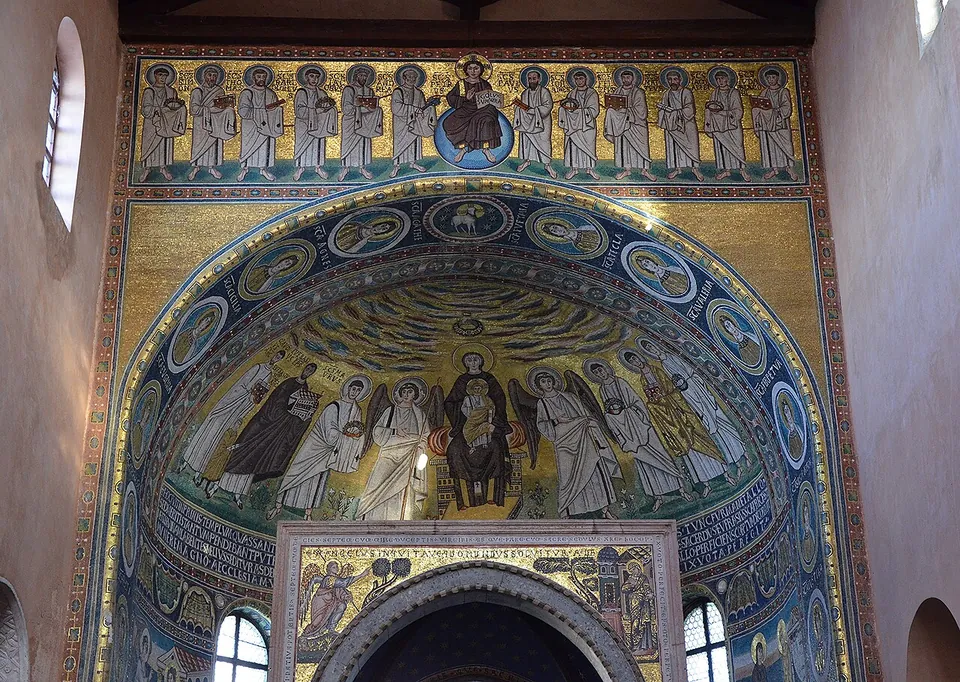
Photo: Carole Raddato · CC BY-SA 2.0 · Commons
45 km · site · Istria County
Euphrasian Basilica
The whole episcopal complex survives: the basilica itself, an atrium surrounded by porticoes with a collection of carved stones, an octagonal baptistery, the bishop's palace and a later bell tower (en.wikipedia).
.jpg)

.jpg)
,_Pula.jpg)


.jpg)
Straight-line distances.
Sources
Every fact on this page comes from the records below, each used under the licence noted.
| Source | Licence |
|---|---|
| Pleiades 627408618 | CC BY |
| Wikidata Q16112130 | CC0 |
| OpenStreetMap way/1038079915 | ODbL |
| Wikipedia (hr) — Malo rimsko kazalište u Puli | CC BY-SA 4.0 |
| Arheološki muzej Istre — Malo rimsko kazalište (the operator) | licence not recorded |