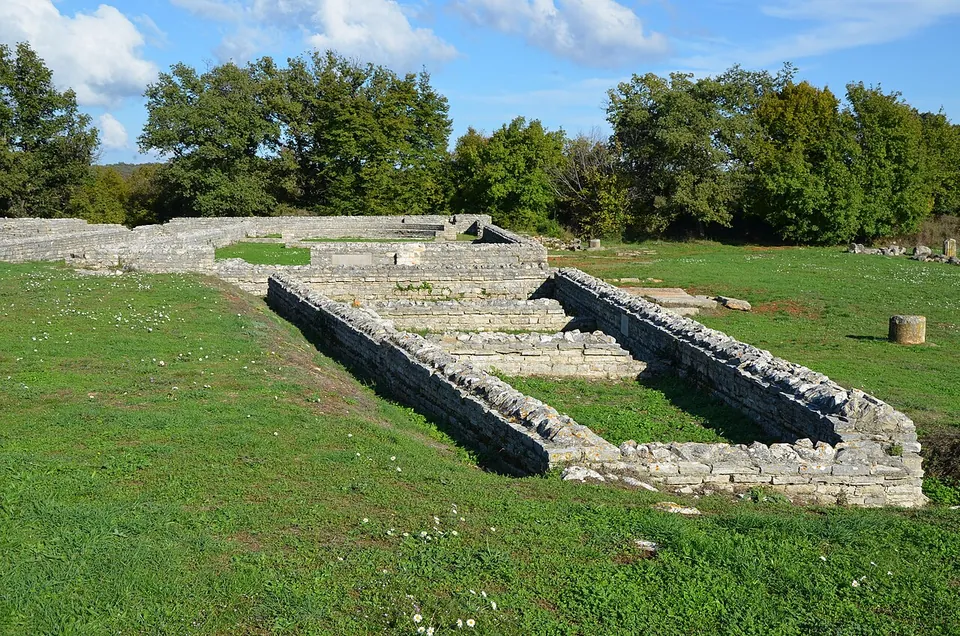
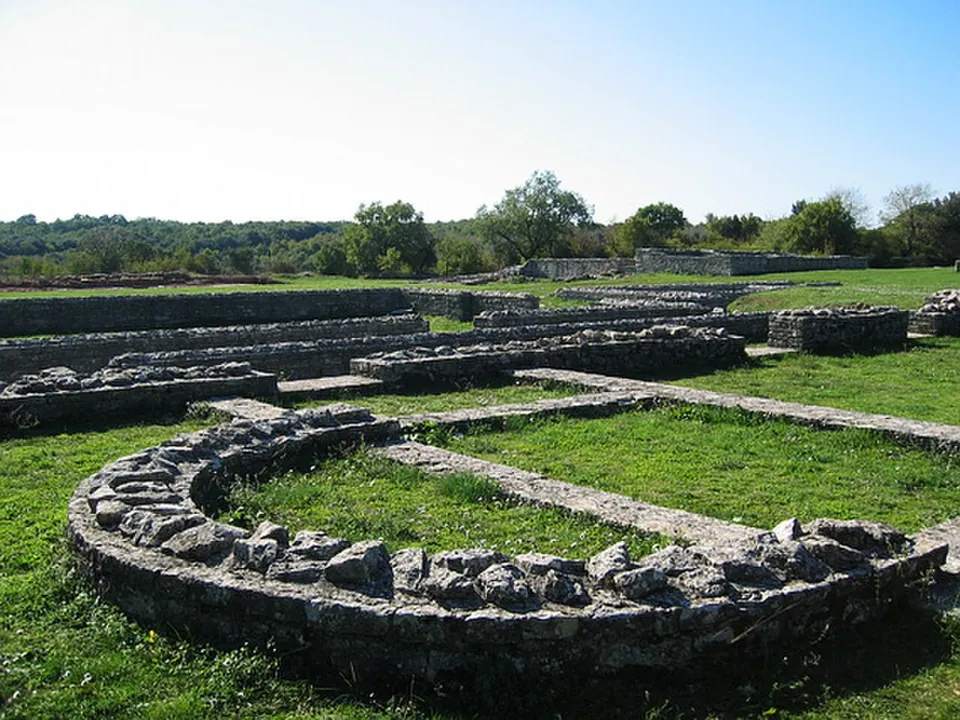
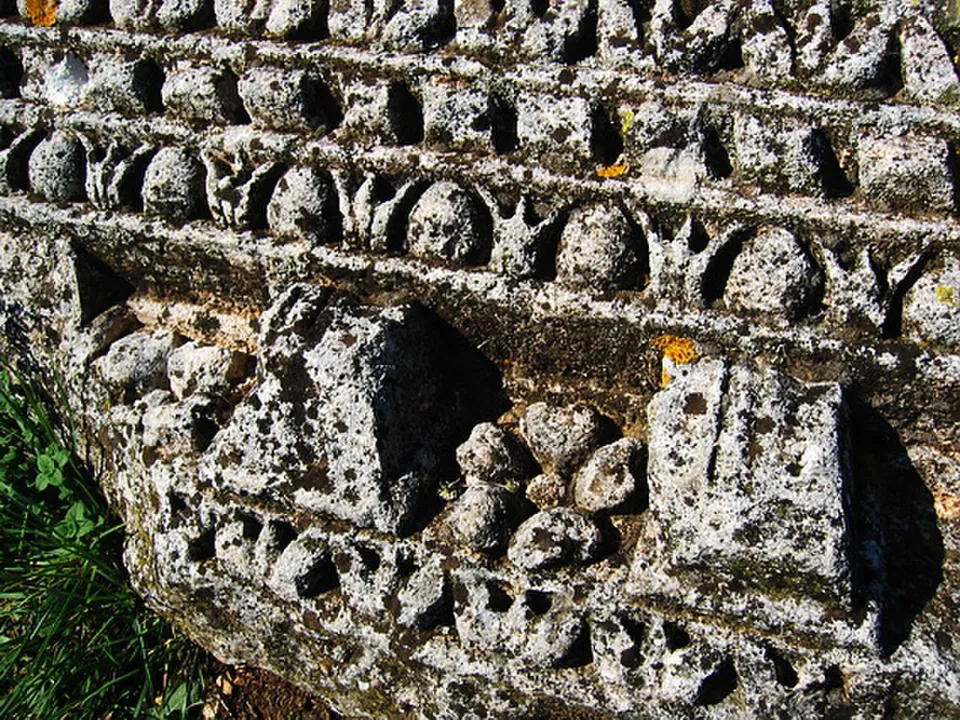
Nesactium was the capital of the Histri, the pre-Roman people of Istria, and after the Romans destroyed it in 177 BC it was rebuilt as a Roman town. Its conserved ruins — forum, temples, baths and two early Christian churches — lie on the hill of Vizače above the Budava bay, about 10 km east of Pula, and you can walk in free any day of the year.
What is there today
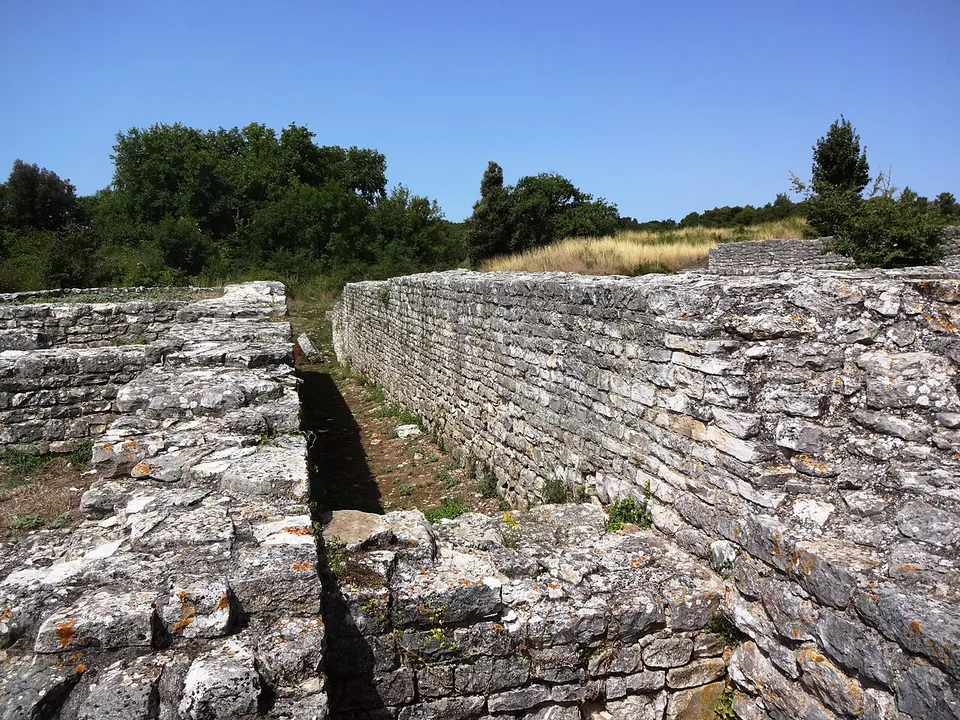
An open archaeological park of conserved walls. On the central plateau the Romans built a forum with three temples and a portico, baths and other public and private buildings; the remains of wealthy private houses lie on the slopes. In the 5th century the southern part of the plateau was rebuilt as two parallel early Christian basilicas, the northern one and the slightly larger southern one, while the baths were turned into houses and workshops. The site is ringed by several belts of prehistoric walls and by the Roman wall, and at the entrance, between the Roman and the prehistoric gates, lay a rich prehistoric cemetery (the operator). A small exhibition goes with the park (the museum’s price list).
Is it worth the trip?
Yes, if you are in southern Istria and want a quieter complement to Pula: it is free, open every day and a short drive from the city, and it shows what the Roman Arena and temple in Pula do not — a whole small town, from its gates to its forum and churches, laid out on a hill. Nothing stands much above head height, so it is a site for walking and reading the plan rather than for monuments.
Getting there
Nesactium lies between the villages of Muntić and Valtura, about 10 km east of Pula (en.wikipedia; de.wikipedia). A car park is mapped about 140 m from the centre of the site (OpenStreetMap). The site can be visited every day all year, entry is free, and a guided tour can be requested (Archaeological Museum of Istria, read 26 September 2026).
Visiting details
- Opening hours
- Open every day, all year round (Archaeological Museum of Istria).
- Tickets
- Free. A guided tour can be requested; the museum's price list gives €20 for a guided tour in Croatian.
- Parking
- A car park is mapped about 140 m from the centre of the site (OSM node/10093228062).
Before you go
- It is an open-air site with no shade to speak of; the museum says wheelchair users can enter by the main gate and move round parts of it.
Hours and prices checked 26 September 2026 on the operator's own site. Confirm before travelling.
History
The Roman historian Livy tells of Nesactium as the royal seat of the Histri, and the legend of Epulo, the last Histrian king, is attached to it (hr.wikipedia; the operator). Its identity was confirmed only at the beginning of the 20th century, when an altar to the emperor Gordian (3rd century) naming the Res Publica Nesactiensium was found here. Burials in the prehistoric cemetery go back to the 11th century BC according to the museum (the 9th according to hr.wikipedia), and imported luxury goods link the Histrian town with most of the Mediterranean and central Europe.
After the siege of 177 BC the Romans pulled the Histrian town down and built a new one on a Roman plan. It kept a degree of municipal self-government within the territory of the colony of Pola. As Roman power weakened it became a late antique fortified community; it survived the fall of the Empire and the coming of Christianity, but not the barbarian attacks at the beginning of the 7th century (the operator; hr.wikipedia).
More photographs
Nearby
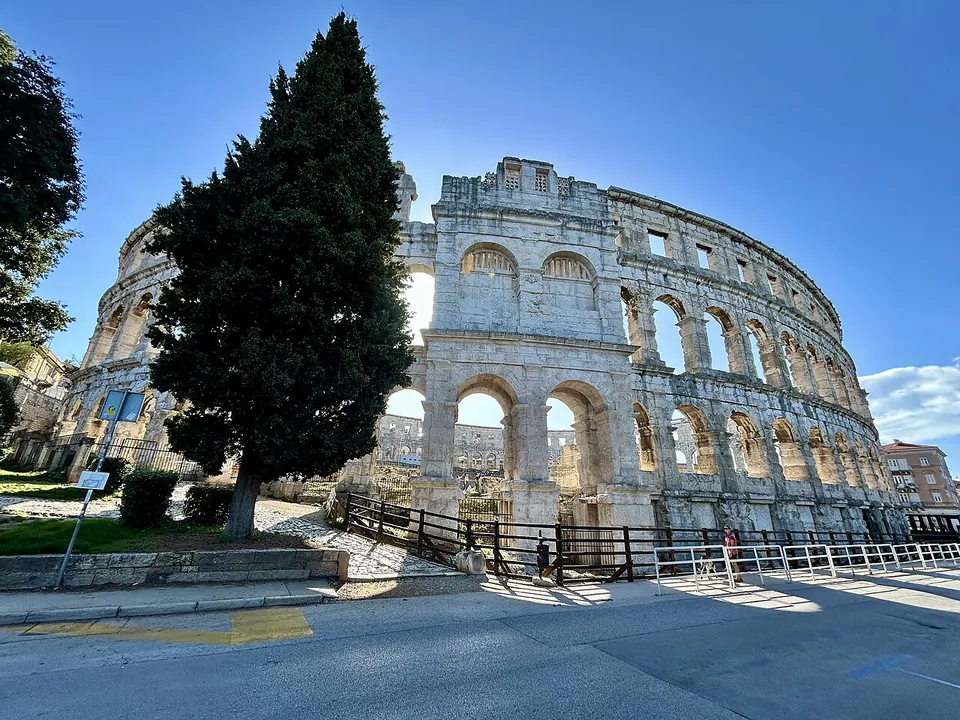
Photo: Olgierd Rudak · CC BY-SA 4.0 · Commons
11 km · amphitheatre · Istria County
Pula Arena
The oval measures about 132 by 105 m, and the wall rises to 32.45 m at its highest (the operator; en.wikipedia).
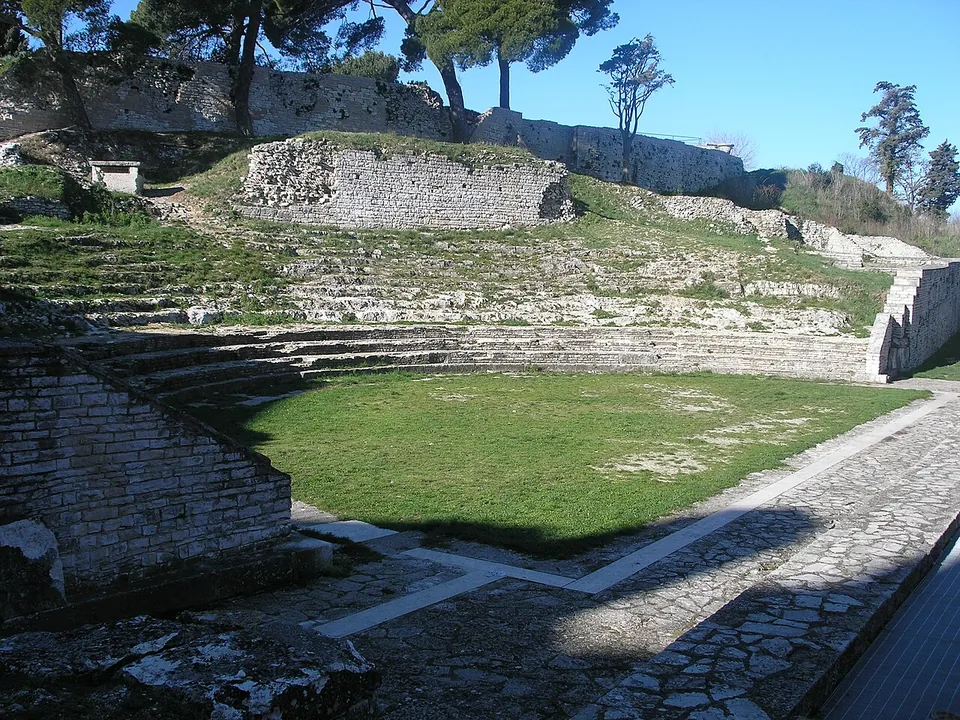
Photo: Orlovic · CC BY-SA 4.0 · Commons
11 km · theatre · Istria County
Small Roman Theatre, Pula
The foundations of the stage building and the semicircular auditorium, its seating partly cut into the living rock of the slope, with the stage and the actors' area on the flat side (the museum; hr.wikipedia).
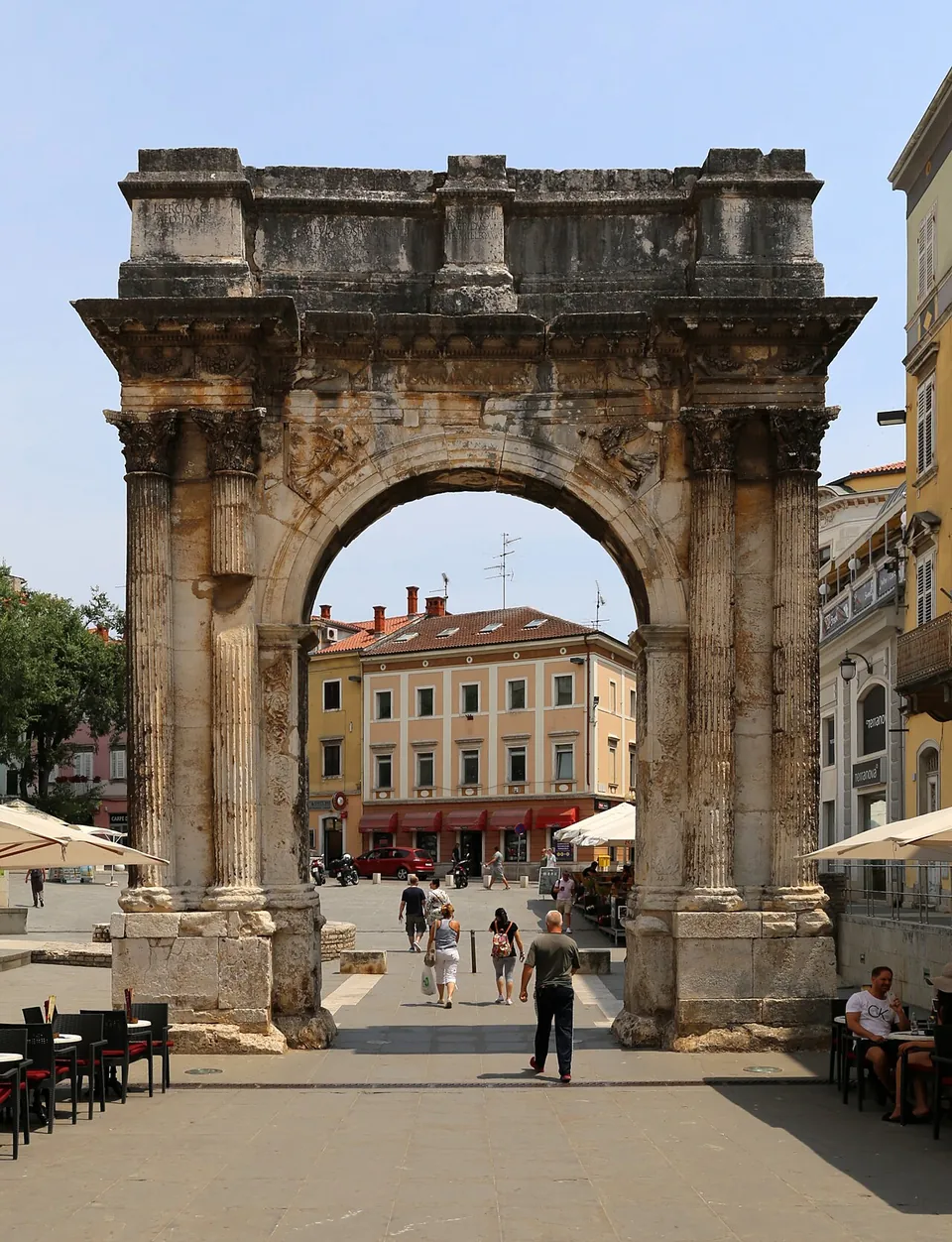


.jpg)


Straight-line distances.
Sources
Every fact on this page comes from the records below, each used under the licence noted.
| Source | Licence |
|---|---|
| Pleiades 197405 | CC BY |
| Wikidata Q923561 | CC0 |
| OpenStreetMap way/426766670 | ODbL |
| Wikipedia (en) — Nesactium | CC BY-SA 4.0 |
| Wikipedia (hr) — Nezakcij | CC BY-SA 4.0 |
| Arheološki muzej Istre — Nezakcij (the operator) | licence not recorded |
| Arheološki muzej Istre — price list (PDF, from 13 May 2025) | licence not recorded |