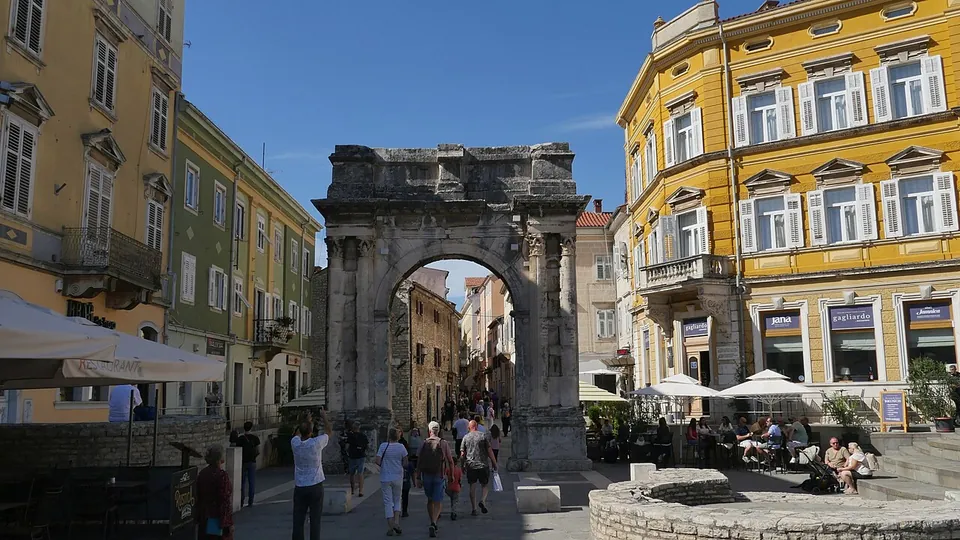
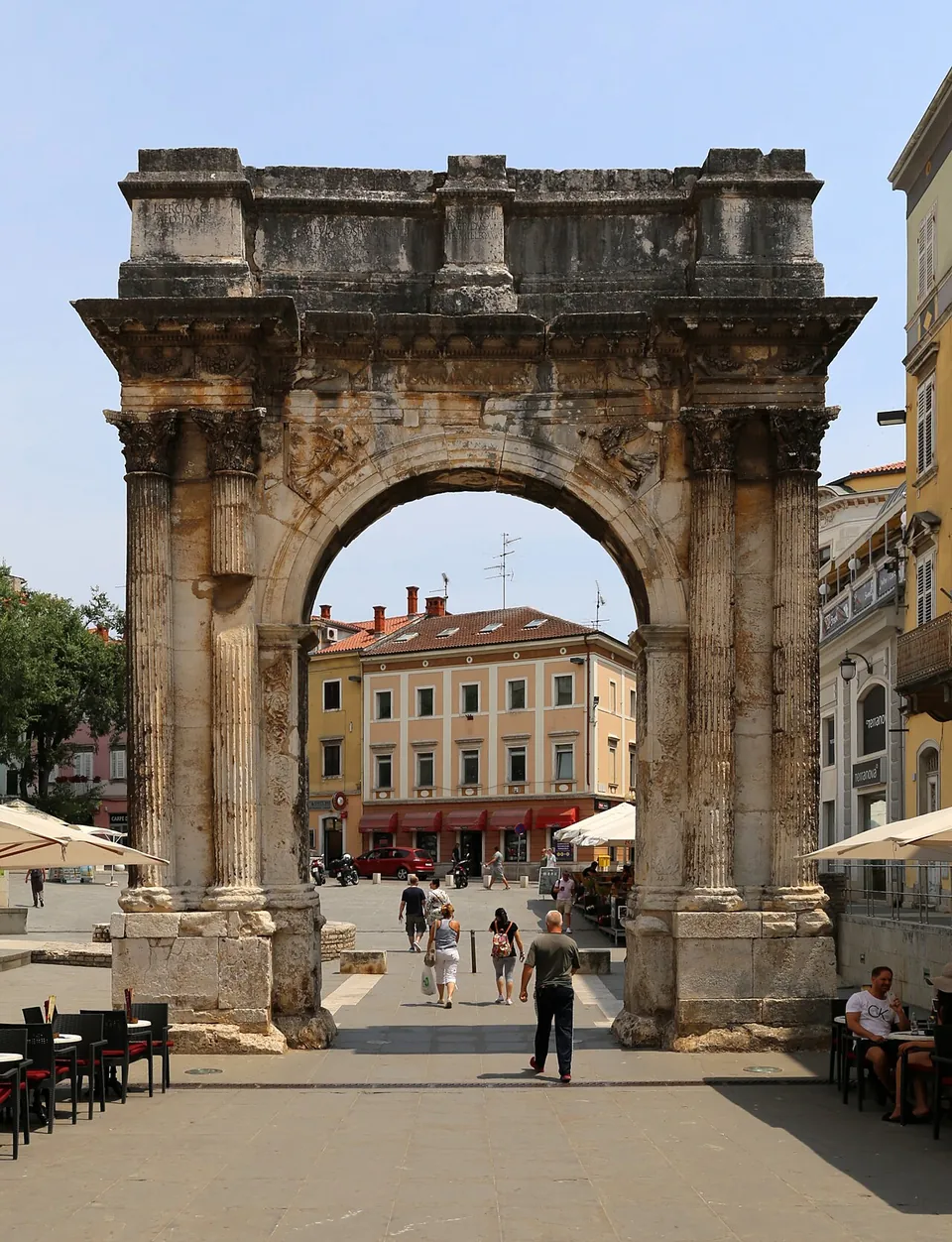
The Arch of the Sergii is a small, richly carved Roman arch that a widow of Pula paid for in honour of her family, built against the inside of the town’s main gate in the reign of Augustus. It stands at the end of the old town’s main street, and you can walk through it.
What is there today
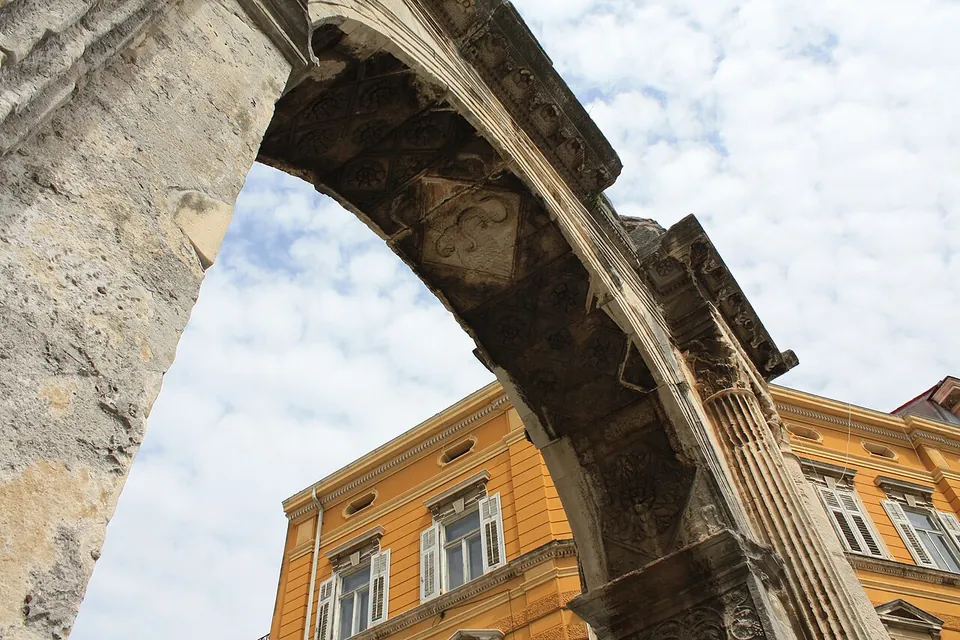
The arch is complete up to its attic. All of its decoration faces the town; the back, which leant against the gate, is plain. The piers are carved with acanthus and vine scrolls, with mating birds and a bird pecking at grapes hidden in the vine on the northern pier. The underside of the arch is covered in coffers with rosettes and palmettes, framed by sphinxes, griffins, sea monsters, hippocamps, a dog and a panther, with an eagle seizing a snake — a symbol of a hero’s apotheosis — at the centre. Winged Victories carrying a wreath and a trophy fill the corners above the arch (the museum).
Five inscriptions name three men and a woman of two generations. The frieze carries the name of Salvia Postuma, who married into the Sergii and paid for the arch with her own money after the other members of the family had died; the three bases on the attic once held statues of her husband, her son Lucius Sergius Lepidus, a military tribune of the Twenty-Ninth Legion, and her brother-in-law, facing into the town (the museum; en.wikipedia).
Is it worth the trip?
It is not a trip on its own, but it is one of the things Pula is worth the trip for, and it costs nothing. Take a few minutes over the carving on the underside; it is easy to walk past with your head down. It has drawn artists from Michelangelo to Piranesi (en.wikipedia).
Getting there
The arch stands in the old town at the end of Sergijevaca street, the main street of Roman Pula, a short walk from the forum and the Arena. It is in a public street, open at all times and free, and the museum notes that visitors with limited mobility can reach it. A bus stop is mapped about 80 m away (OpenStreetMap).
Visiting details
- Tickets
- Free
- Parking
- None at the arch; the nearest mapped car park is about 200 m away, and a bus stop about 80 m (OpenStreetMap).
- On foot
- At the parking
History
Pula’s walls had many gates — the museum counts twelve, English Wikipedia ten — and the Golden Gate was the main entrance to the colony. Under Augustus it was rebuilt as a triple gate with round towers, and the Sergii arch was built against its inner side (the museum). The gate itself was demolished in the middle of the 19th century; the arch survived (the museum).
Lucius Sergius Lepidus, the man at the centre of the monument, was an aedile of Pola and a tribune of the Twenty-Ninth Legion, disbanded after the battle of Actium; he fought on Octavian’s side in the civil war and died young, at the start of a senatorial career, and his grieving mother raised the arch at the main entrance to her town near the end of her life (the museum). English Wikipedia dates the arch to about 29–27 BC from Lepidus’s career; the museum dates it to the end of the 1st century BC or the start of the 1st century AD.
Nearby
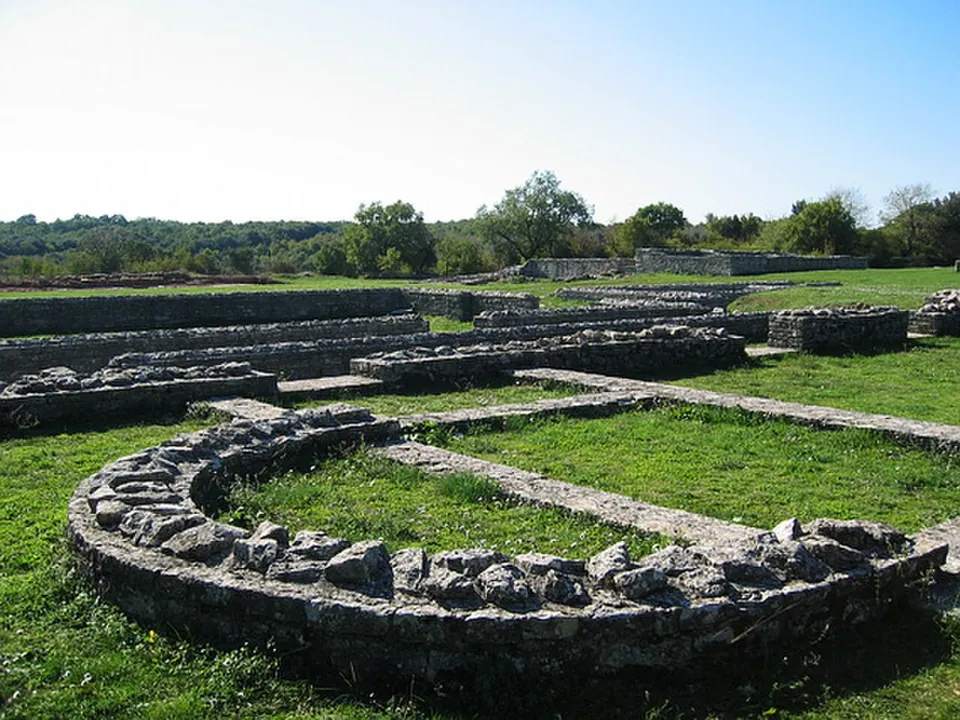
Photo: Hieronymushistriae · CC BY-SA 3.0 · Commons
45 km · city · Istria County
Parentium – Poreč
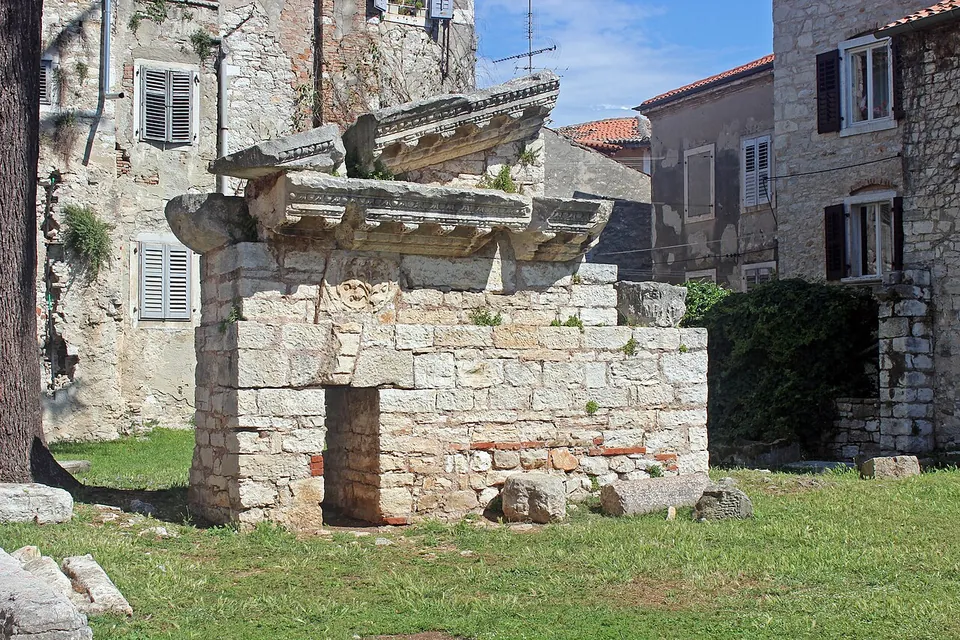
The town plan still shows the shape of the Roman castrum, and the two main streets, the Decumanus and the Cardo Maximus, keep their original lines.
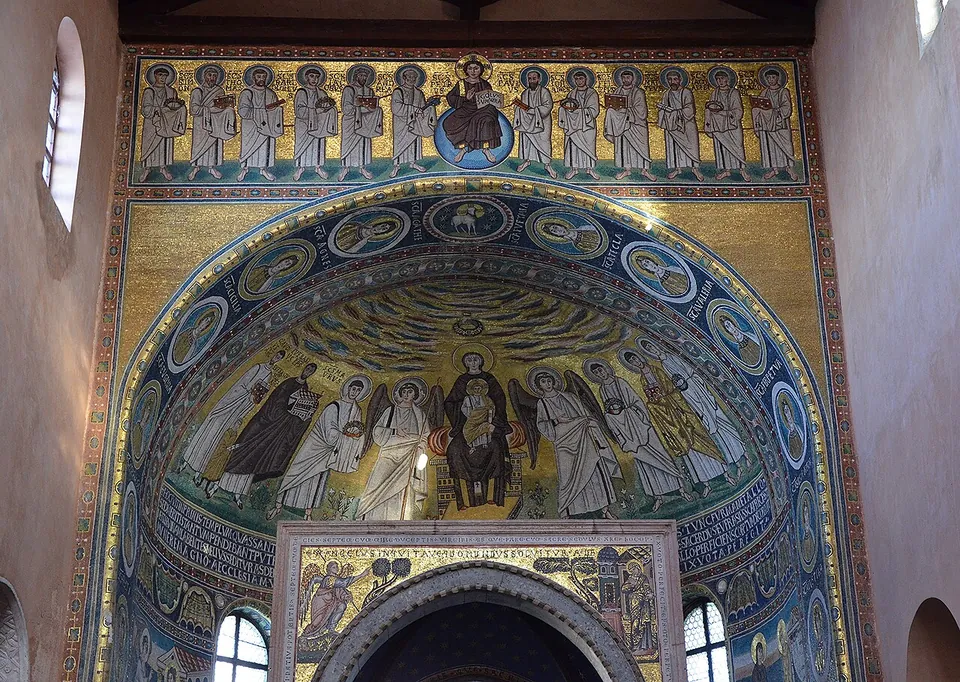
Photo: Carole Raddato · CC BY-SA 2.0 · Commons
45 km · site · Istria County
Euphrasian Basilica
The whole episcopal complex survives: the basilica itself, an atrium surrounded by porticoes with a collection of carved stones, an octagonal baptistery, the bishop's palace and a later bell tower (en.wikipedia).


_-_panoramio.jpg)


.jpg)
Straight-line distances.
Sources
Every fact on this page comes from the records below, each used under the licence noted.
| Source | Licence |
|---|---|
| Pleiades 471437511 | CC BY |
| Wikidata Q952381 | CC0 |
| OpenStreetMap way/203755793 | ODbL |
| Wikipedia (en) — Arch of the Sergii | CC BY-SA 4.0 |
| Arheološki muzej Istre — Slavoluk Sergijevaca | licence not recorded |
| Arheološki muzej Istre — Gradske zidine s vratima | licence not recorded |