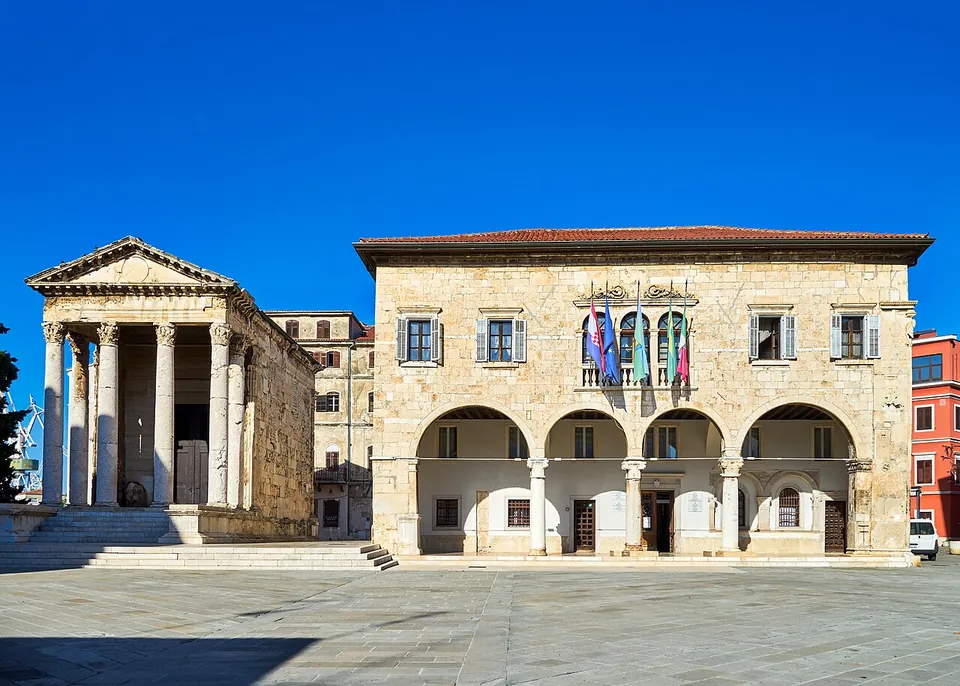
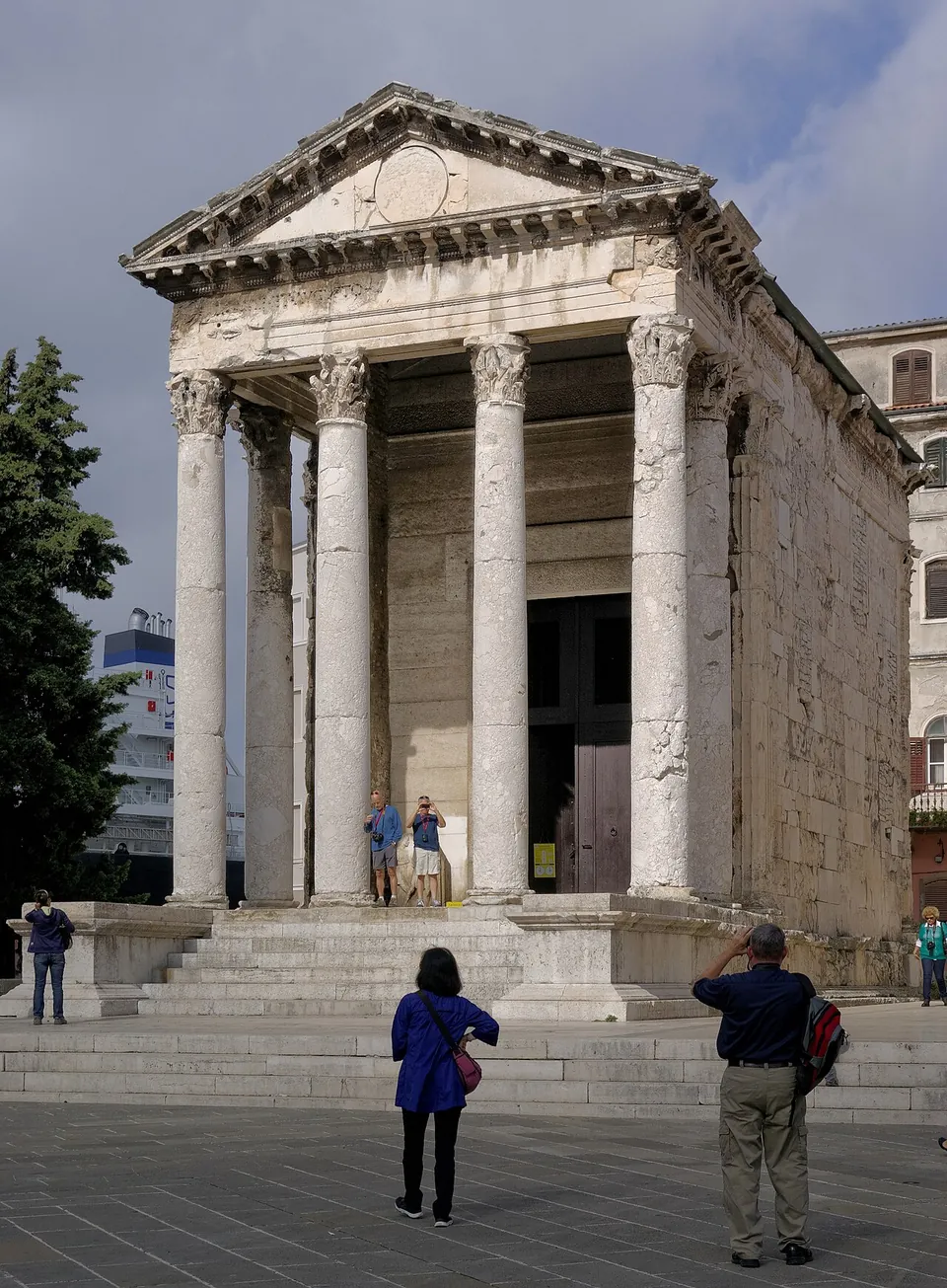
The Temple of Augustus is a small Roman temple on Pula’s forum square, dedicated to the goddess Roma and the emperor Augustus in his own lifetime, and it stands complete on its podium, porch and all, though much of it was rebuilt after the Second World War. Inside is a small display of Roman sculpture.
What is there today
The temple is about 13 m high, 8.5 m wide and 17.65 m long: a closed shrine behind a porch of six Corinthian columns, four of them across the front. Above them runs a frieze carved with acanthus scrolls, fruit and birds (the operator). The dedication on the front architrave once read ROMAE ET AVGVSTO CAESARI DIVI FILIO PATRI PATRIAE — “to Rome and Augustus Caesar, son of the god, father of the fatherland” — in bronze letters; only the holes for their nails remain (en.wikipedia; the operator). It stood as one of a pair on the north-west side of the forum. The back wall of the other, eastern temple can still be seen in the rear wall of the town hall next door (the operator). Today the temple houses an exhibition of Roman sculpture.
Is it worth the trip?
Yes, and it takes minutes rather than hours. English Wikipedia counts it and the Maison Carrée in Nîmes as the two best complete Roman monuments outside Italy, and it is right on the main square, so it fits into any walk round Pula. Be aware that much of what you see was rebuilt after the building was bombed in the Second World War. The building itself is the point; the sculpture inside is a bonus.
Getting there
The temple is on the Forum, Pula’s main square, in the old town (the operator). A car park is mapped about 100 m away (OpenStreetMap).
It opens from April to October: 08.00 to 19.30 in spring and September, until 21.00 in July and August, and until 19.00 in October, with ticket sales ending half an hour before closing. Entry is €2, or €1 for pupils and students (Archaeological Museum of Istria, read 26 September 2026). High steps lead up to the door.
Visiting details
- Opening hours
- April to June 08.00–19.30; July and August 08.00–21.00; September 08.00–19.30; October 08.00–19.00. Ticket sales stop 30 minutes before closing. No winter hours are published.
- Tickets
- €2 for adults, €1 for pupils and students (the Archaeological Museum of Istria). Tickets are sold at the door only.
Before you go
- High steps lead up to the entrance; the operator says the temple is not accessible to visitors with limited mobility.
Hours and prices checked 26 September 2026 on the operator's own site. Confirm before travelling.
History
The temple and its twin were built on a platform on the north-west side of the forum, and an older temple from the first years of the Roman colony was demolished to make room; its foundations are marked in the paving beside the temple and under the town hall (the operator). The dedication to a living Augustus, with the title Pater Patriae he received in 2 BC, dates the temple to between 2 BC and his death in AD 14 (the operator; en.wikipedia).
After paganism was banned at the end of the 4th century the temple became a church. Between the 11th and 13th centuries a door linked it to the palace built against its east side; a fire in the early 17th century destroyed its roof, and it later served as a granary, a store and the town archive. A bomb hit it in the Second World War, and restoration in the following years gave it back its original form (the operator; en.wikipedia). In the 16th century Andrea Palladio described it in his Four Books of Architecture (en.wikipedia).
Nearby
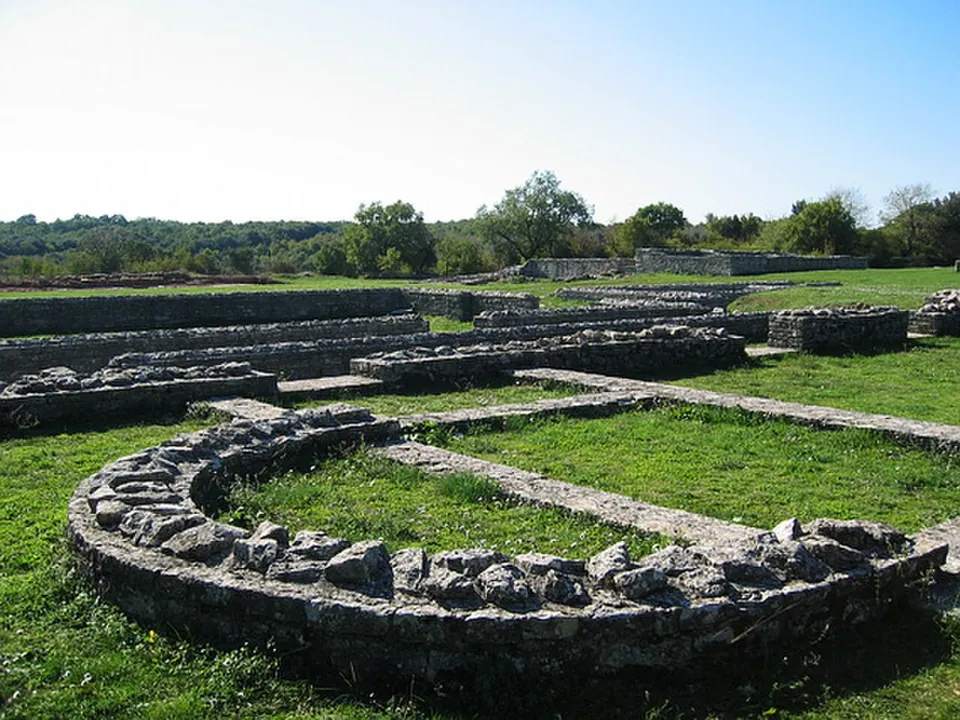
Photo: Hieronymushistriae · CC BY-SA 3.0 · Commons
44 km · city · Istria County
Parentium – Poreč
The town plan still shows the shape of the Roman castrum, and the two main streets, the Decumanus and the Cardo Maximus, keep their original lines.
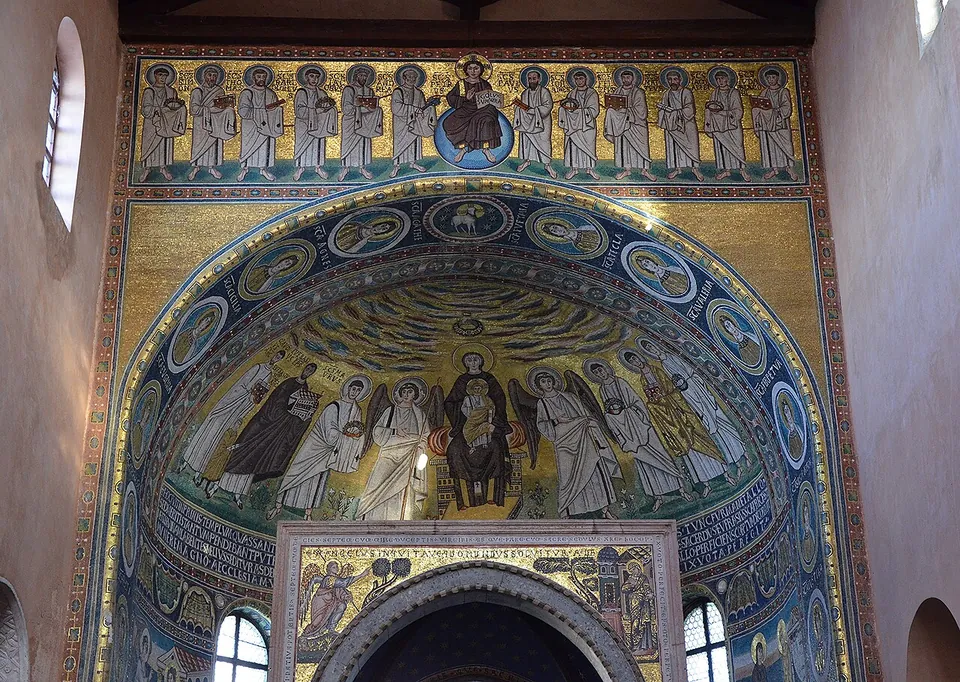
Photo: Carole Raddato · CC BY-SA 2.0 · Commons
44 km · site · Istria County
Euphrasian Basilica
The whole episcopal complex survives: the basilica itself, an atrium surrounded by porticoes with a collection of carved stones, an octagonal baptistery, the bishop's palace and a later bell tower (en.wikipedia).


.jpg)
Straight-line distances.
Sources
Every fact on this page comes from the records below, each used under the licence noted.
| Source | Licence |
|---|---|
| Pleiades 391553443 | CC BY |
| Wikidata Q770030 | CC0 |
| OpenStreetMap way/119102927 | ODbL |
| Wikipedia (en) — Temple of Augustus, Pula | CC BY-SA 4.0 |
| Arheološki muzej Istre — Augustov hram (the operator; hours, prices, description) | licence not recorded |
| Arheološki muzej Istre — price list (PDF, from 13 May 2025) | licence not recorded |