_03.jpg)
.jpg)
_01.jpg)
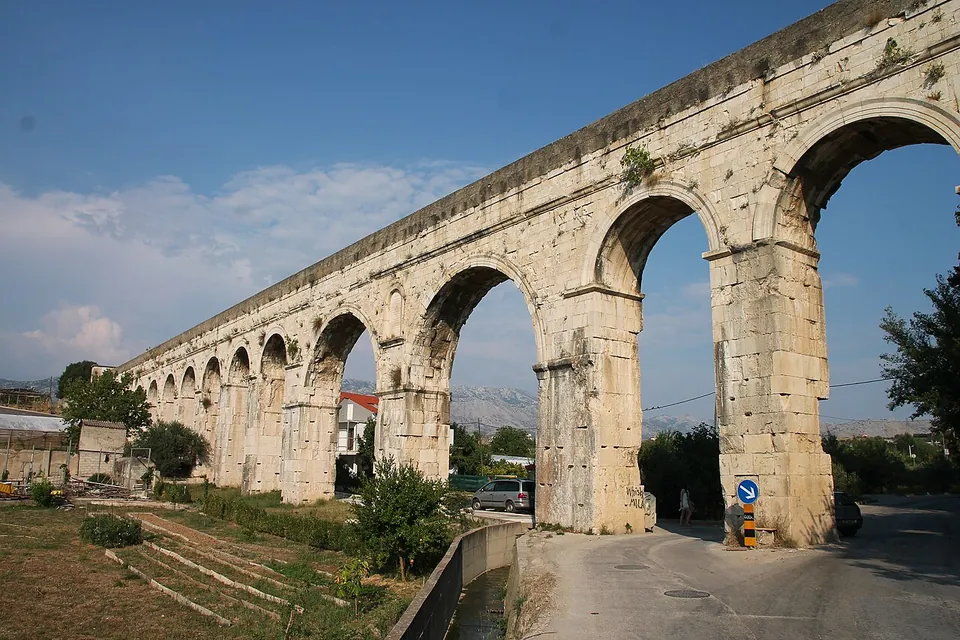
Photo: Draceane · CC BY-SA 4.0 · Commons
.jpg)
Stop 1 · aqueduct · Split-Dalmatia County
Diocletian's Aqueduct
The channel runs through cuttings and tunnels or is dug into the rock, and where it crosses low ground it rides on arches (hr.wikipedia).
Martia Iulia Valeria Salona Felix
city · Split-Dalmatia County, Croatia
About 2.1 km and 27 minutes on foot from the centre of Salona, plus time at the stop.
Walking times are estimates: the straight-line distance × 1.3 for streets, at 80 m a minute.
Photo: Draceane · CC BY-SA 4.0 · Commons
Stop 1 · aqueduct · Split-Dalmatia County
The channel runs through cuttings and tunnels or is dug into the rock, and where it crosses low ground it rides on arches (hr.wikipedia).
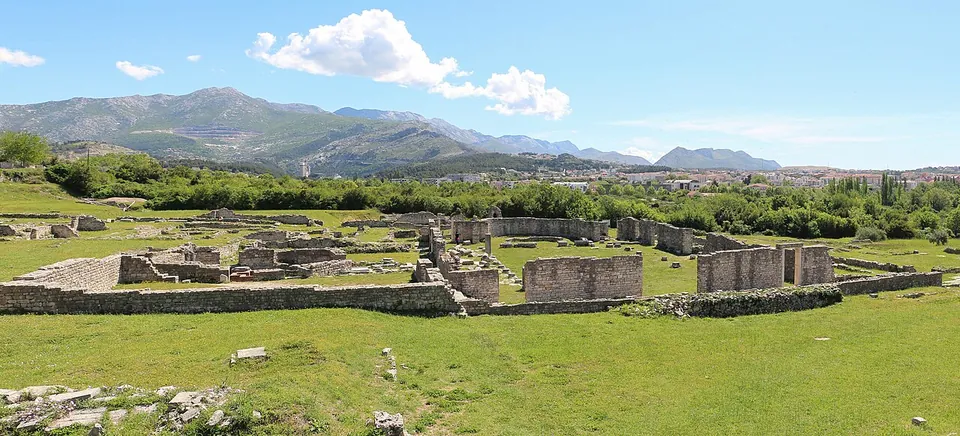
A spread-out archaeological park rather than a single monument: the ruins run across fields and roads between the houses of Solin, and English Wikipedia calls it the largest archaeological park in Croatia. The walls, forum, theatre, amphitheatre, public baths and aqueduct are the most conspicuous remains (en.wikipedia).
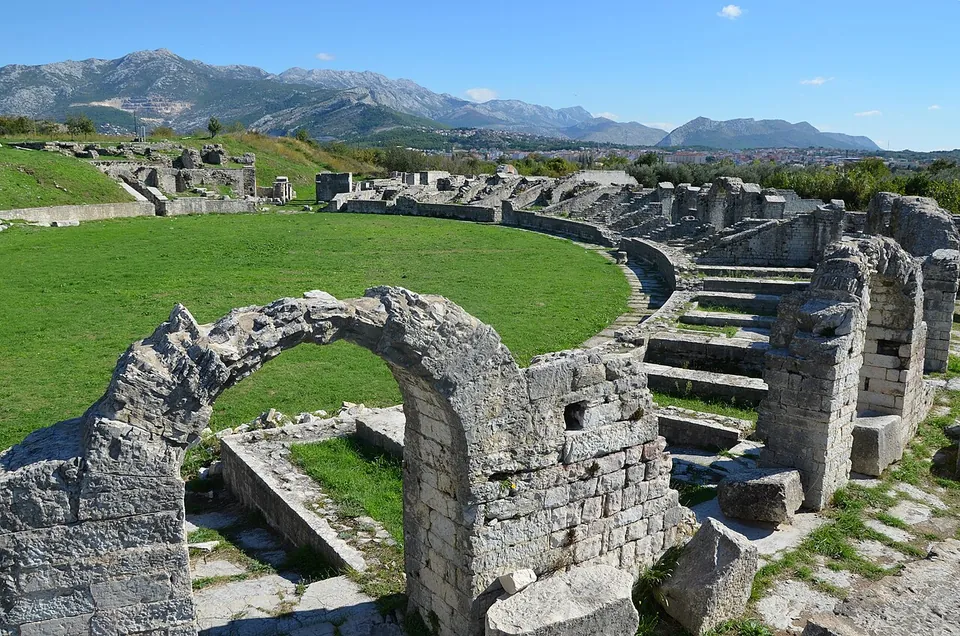
At the western edge of the city stands an amphitheatre of the second half of the 2nd century, built into a hillside, with three storeys on the south side and one on the north. It measured about 125 by 100 m and held an estimated 15,000 to 18,000 spectators. Christians were executed here during Diocletian’s persecutions. The Venetians demolished much of it in the 17th century for strategic reasons, so only its lower structures and fragments of its decoration survive (en.wikipedia).
The best-preserved and largest of the city’s baths, built in the 2nd or early 3rd century in the eastern town: a rectangular building with apses, a cold pool, changing rooms with benches and wall niches for clothes, a massage room, and hot rooms and a sauna (en.wikipedia).
A theatre of about 65 by 58 m, built in the 1st century AD, beside the forum in the oldest part of the city; a temple to Dionysus or Liber stood south of it (en.wikipedia). Little more than the outline of its seating is visible.
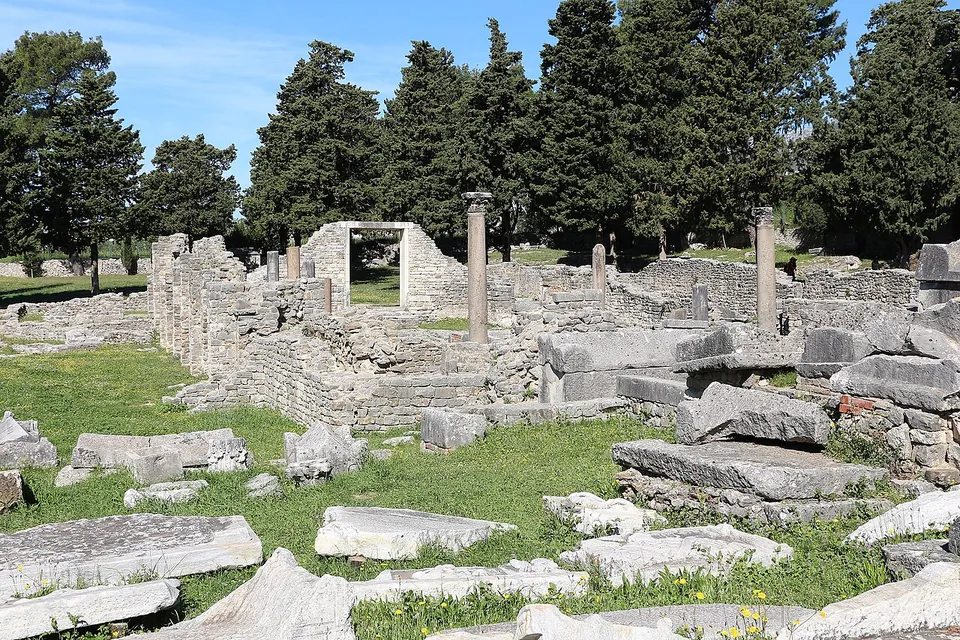
Outside the walls lies Manastirine, a basilica and cemetery where the bishop Saint Domnius was buried after his execution in the amphitheatre in 304. A three-aisled basilica was built over the ruined complex in the mid-5th century, and Christians were buried around it as close to the martyr as they could be; many sarcophagi remain (en.wikipedia). The ticket office is in the Tusculum building beside it.
Also on the circuit are the Porta Caesarea, the gate of the early city, with two octagonal towers and three passages; the episcopal centre, twin basilicas, a baptistery and a bishop’s palace of the 5th century; and stretches of the aqueduct Augustus built to bring water from the river Jadro (en.wikipedia).
Yes, if you give it time and imagination. This was a capital city of tens of thousands, and walking its streets, churches and cemeteries is a different experience from Split’s single palace. But almost everything is at foundation level, spread over a large area, and much of it is unshaded, so on a hot afternoon it can feel like a long walk through fields of stones. Go in the morning, start at the Tusculum, and combine it with Diocletian’s Palace, built by the emperor who was born here.
Salona is in Solin, about 6 km from Split (en.wikipedia). The ticket office and small collection are in the Tusculum, the museum’s building at Don Frane Bulića 91 by the Manastirine cemetery (the operator).
The site is open every day: 09.00 to 20.00 from June to September and 09.00 to 18.00 from October to May, and it is closed on public holidays. A ticket is €8, or €4 for children, pupils, students and pensioners, and free under six; a combined ticket with the Archaeological Museum in Split, valid for seven days, is €10 (Archaeological Museum in Split, read 26 September 2026).
Before you go
Hours and prices checked 26 September 2026 on the operator's own site. Confirm before travelling.
Salona grew up on the river Jadro in the 3rd century BC, near the Greek towns of Tragurium and Epetium, in the territory of the Illyrian Delmatae. It became the capital of Dalmatia because it sided with Caesar in the civil war against Pompey, and was made a colony, probably under Caesar. Its walls, first built in the 2nd century BC, were extended around 170 under Marcus Aurelius to take in the eastern and western suburbs, with at least 90 towers. Diocletian was born here and built his retirement palace 6 km away (en.wikipedia).
The city prospered into late antiquity: churches, an episcopal basilica and martyrs’ shrines were built in the 4th and 5th centuries, making Salona a key site for the history of Christian architecture. It was the last residence of the last Western emperor, Julius Nepos, from 476 to 480. In the early 7th century Avars and Slavs destroyed it; the date is disputed, traditionally 614, with opinions ranging from 608 to 639. Refugees took shelter inside Diocletian’s Palace, which became the town of Split (en.wikipedia).
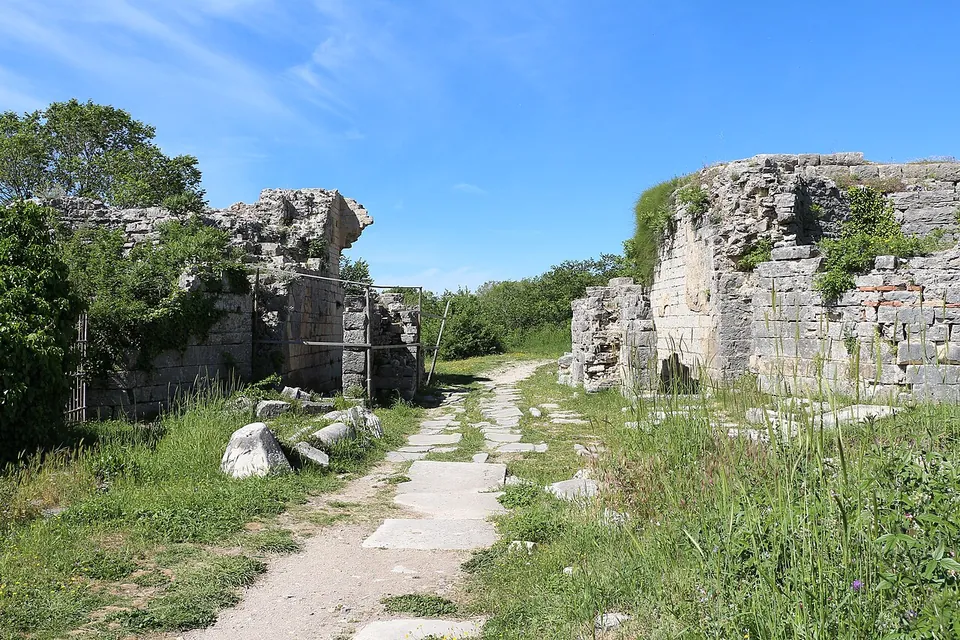
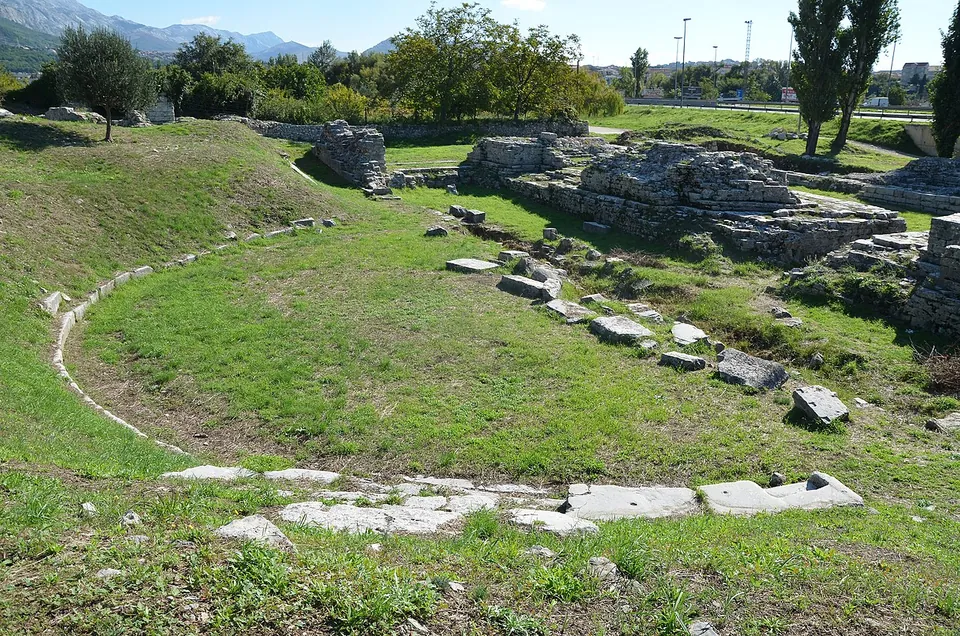
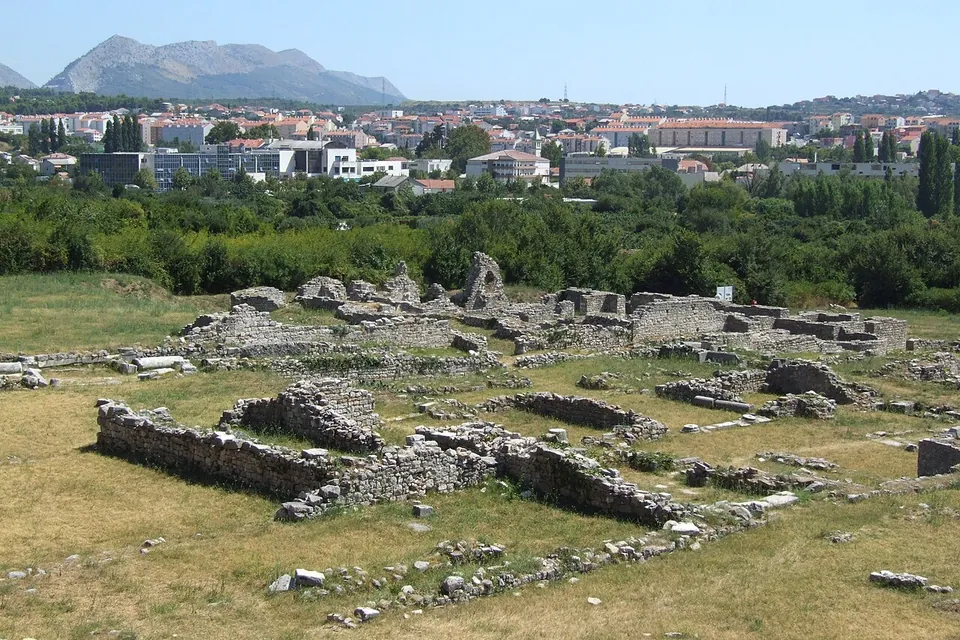
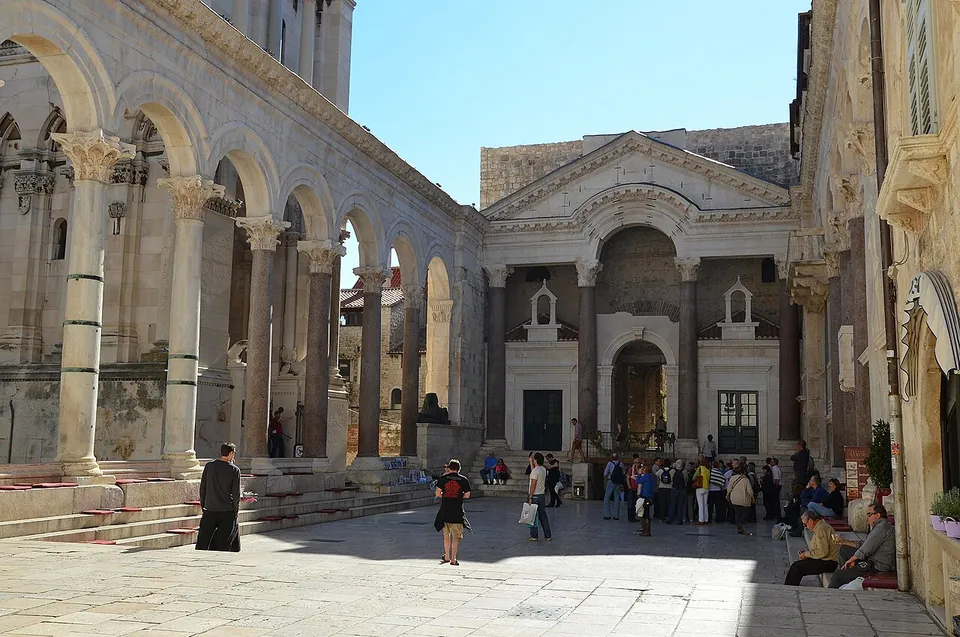
Photo: Following Hadrian · CC BY-SA 2.0 · Commons
5 km · palace · Split-Dalmatia County
The palace is an irregular rectangle of roughly 215 by 175–180 m, laid out like a legionary fort, with towers on its three landward walls and a gate in the middle of each side.
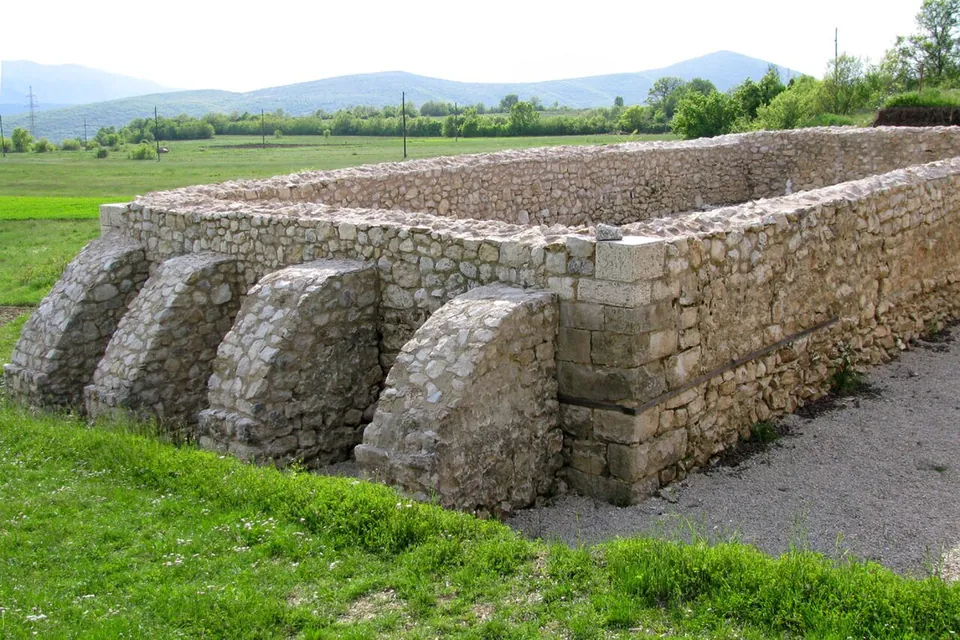
Photo: Ante Perković · CC BY-SA 3.0 · Commons
20 km · fort · Split-Dalmatia County
The camp covered about 12 hectares, and the village of Gardun sits over it (en.wikipedia).
Straight-line distances.
Every fact on this page comes from the records below, each used under the licence noted.
| Source | Licence |
|---|---|
| Pleiades 197488 | CC BY |
| Wikidata Q1258998 | CC0 |
| Vici.org 2037 | CC BY-SA (text), CC0 (metadata) |
| OpenStreetMap way/555296067 | ODbL |
| Wikipedia (en) — Salona | CC BY-SA 4.0 |
| Arheološki muzej u Splitu — opening hours (the operator) | licence not recorded |
| Arheološki muzej u Splitu — ticket prices | licence not recorded |
.jpg)
_and_two_tiers_of_seats_that_could_accommodate_3,000_spectators,_built_in_the_mid-1st_century_AD,_Salona,_Dalmatia_(12287570263).jpg)

.jpg)
