Skip to content
Menu
LandmarkHub · 1stop1st – 6th c. ADTicketed

Emona – Ljubljana

Aemona, Colonia Iulia Aemona

city · Ljubljana, Slovenia

What it is
Roman Emona was a walled town laid out in the centre of what is now Ljubljana, built by the year AD 15 and lived in until the 6th century.
What you’ll see
The best of it is in two small archaeological parks run by the city museum (MGML). At Emonan House, in the former Jakopič Garden at Mirje, excavations in 1963–1964 uncovered a house of the late 4th and early 5th centuries.
Worth the trip?
As a reason to go to Ljubljana, no — Emona is a scatter of foundations, not a town you can walk through, and the houses survive as low foundations.
Getting there & cost
Everything is in central Ljubljana, on foot. Emonan House is at Mirje 4, the Early Christian Centre at Erjavčeva 18, and tickets are sold at the City Museum, Gosposka 15, together with a map of the Roman trail.Ticketed · Archaeopark €6 (reduced €4, family €14) · checked 26 September 2026Hours, tickets and parking
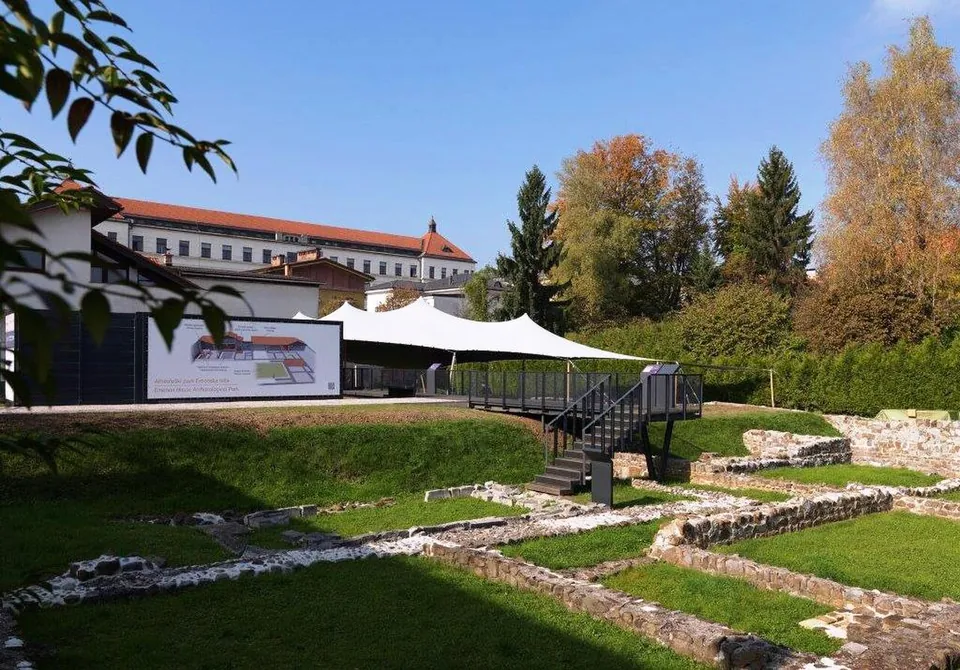
A sunken lawn crossed by low excavated stone walls, with a black metal viewing platform and steps, a white fabric canopy behind it, an illustrated information panel on the left and a large red-roofed building beyond the trees.
The Emonan House archaeological park at Mirje. · Photo: Matevž Paternoster, dokumentacija Muzeja in galerij mesta Ljubljane · CC BY-SA 3.0 · Wikimedia Commons
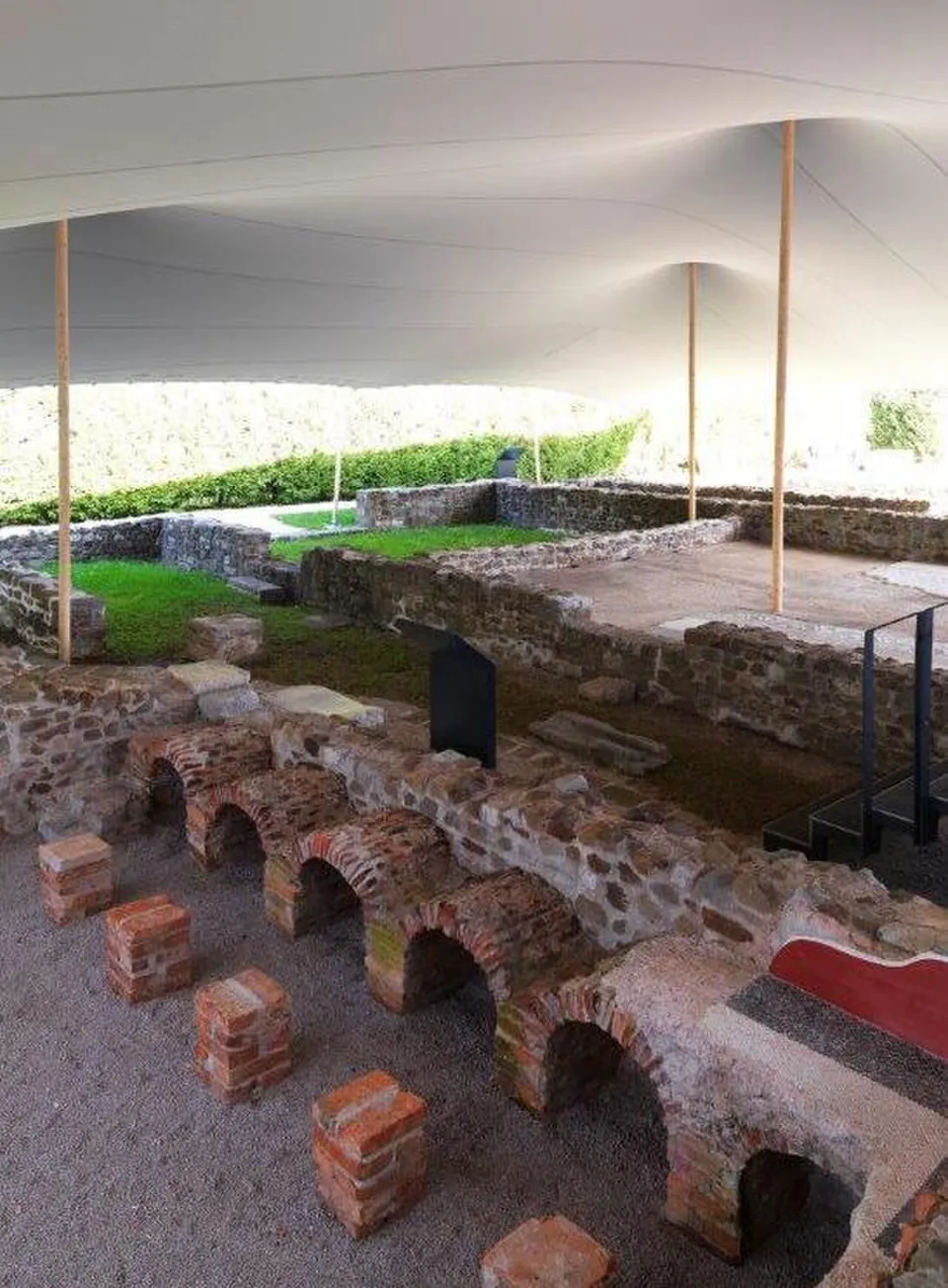
A row of small round-headed brick arches and free-standing square brick stacks set low in the ground under a white fabric canopy, with stone wall footings and a lawn beyond.
The hypocaust of the house's winter room. Hot air from a furnace next door ran under the floor through these channels. · Photo: Matevž Paternoster, dokumentacija Muzeja in galerij mesta Ljubljane · CC BY-SA 3.0 · Wikimedia Commons
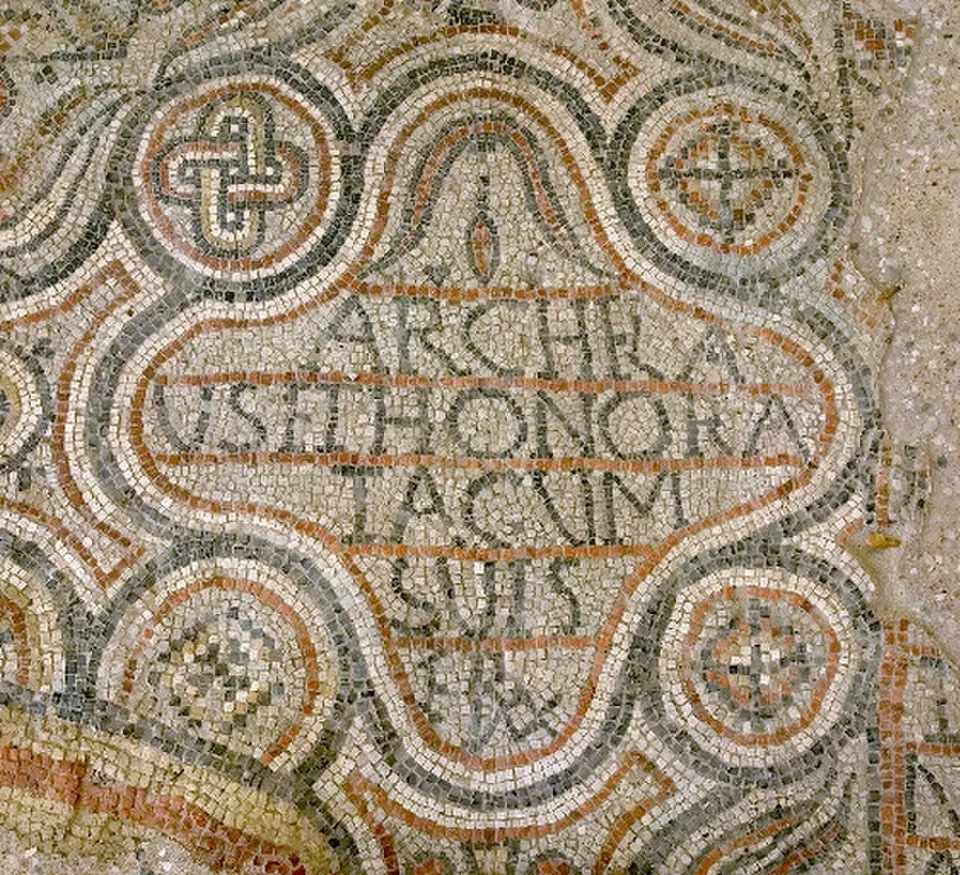
A mosaic panel of small white, grey and red stones, an inscription in capital letters framed by a looping border with cross motifs in roundels around it.
A donors' inscription in the baptistery mosaic of the Early Christian Centre. Archelaus and Honorata and their family paid for twenty feet of the floor. · Photo: Matevž Paternoster, dokumentacija Muzeja in galerij mesta Ljubljane · CC BY 3.0 · Wikimedia Commons

Walking route

HEmona1
Schematic, generated at build time from each stop's coordinates; no streets are drawn. Some positions are approximate, so the route is a guide, not a path. Open on the interactive map →

Walk it in this order

About 350 m and 5 minutes on foot from the centre of Emona, plus time at the stop.

Walking times are estimates: the straight-line distance × 1.3 for streets, at 80 m a minute.

The stops

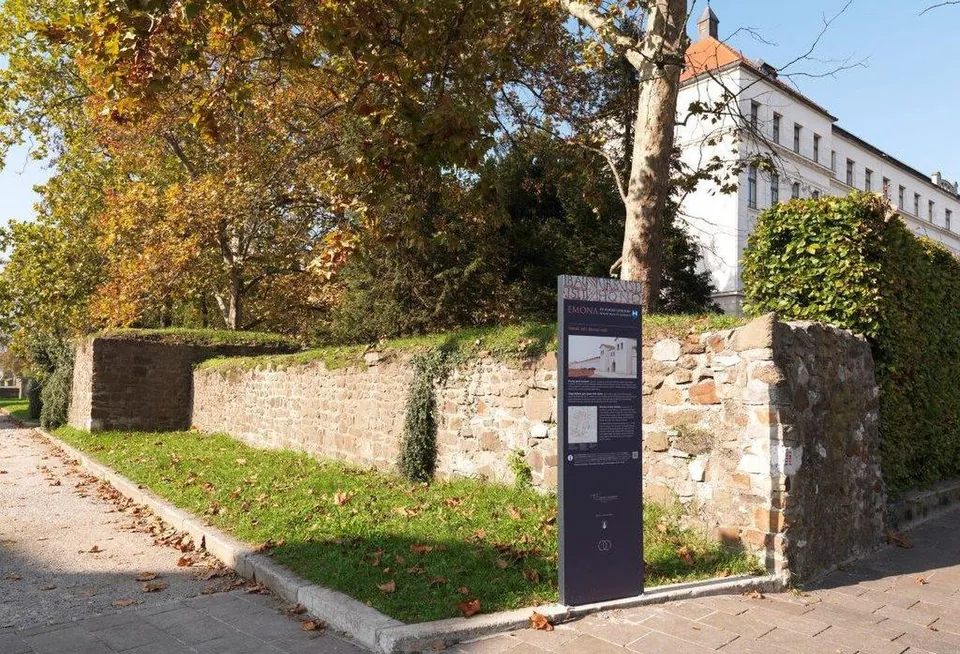
  1. A stretch of rough stone wall capped with turf, with a square tower projecting at its far end, a paved pavement in front and a dark information stele standing against it; autumn trees and a large white building behind.

    Photo: Matevž Paternoster, dokumentacija Muzeja in galerij mesta Ljubljane · CC BY-SA 3.0 · Commons

    Stop 1 · wall · Ljubljana

    Roman Walls in Mirje

    A long wall of rubble stone, grassed along the top, with square towers projecting from it, runs through a park between Aškerčeva cesta and the street Mirje, from the junction with Barjanska cesta to the junction with Snežniška ulica.

Roman Emona was a walled town laid out in the centre of what is now Ljubljana, built by the year AD 15 and lived in until the 6th century. It lies under the modern city, so you see it in pieces: two excavated houses kept as open-air parks and a stretch of the town wall.

What is there today

The best of it is in two small archaeological parks run by the city museum (MGML). At Emonan House, in the former Jakopič Garden at Mirje, excavations in 1963–1964 uncovered a house of the late 4th and early 5th centuries. What you walk round are its foundations: a summer room once floored with a two-coloured mosaic, and a winter room whose hypocaust — the brick underfloor heating — is still in place. The Early Christian Centre on Erjavčeva cesta, opposite Cankarjev dom, is a house begun in the 1st century that was rebuilt several times, until one part became a chapel and, in the early 5th century, a baptistery was added with a small pool at its centre. Its floor mosaic carries the names of the townspeople who paid for it (MGML).

The third piece is the southern town wall at Mirje, renovated in the 20th century by the architect Jože Plečnik and now a public park; it has its own page, below. The operator also publishes a circular trail of ten Roman sites across the centre.

Is it worth the trip?

As a reason to go to Ljubljana, no — Emona is a scatter of foundations, not a town you can walk through, and the houses survive as low foundations. As part of a day in Ljubljana, in summer, yes: the two parks are well presented, and the hypocaust and the baptistery mosaics are the kind of domestic detail that bigger sites bury. Out of season the parks are shut and the wall at Mirje is what is left.

Getting there

Everything is in central Ljubljana, on foot. Emonan House is at Mirje 4, the Early Christian Centre at Erjavčeva 18, and tickets are sold at the City Museum, Gosposka 15, together with a map of the Roman trail. The nearest bus stop to the centre of the Roman town is Drama, about 120 m from the point on the map (OpenStreetMap).

The parks open only in season — 15 May to 15 September in 2026 — from 14.00 to 18.00 on weekdays except Monday and from 10.00 to 18.00 at weekends. A ticket is €6 (€4 reduced, €14 for a family); €12 buys a combined ticket with the City Museum, which is open all year from Tuesday to Sunday, 10.00 to 18.00. Guided tours of the parks run on published dates for €11 (MGML, read 26 September 2026 — check before travelling).

Visiting details

Opening hours
The two archaeological parks (Emonan House and the Early Christian Centre) are open in season only — 15 May to 15 September in 2026 — Tuesday to Friday 14.00–18.00 and Saturday and Sunday 10.00–18.00. The City Museum is open all year, Tuesday to Sunday 10.00–18.00, closed Mondays, 1 January, 1 November and 25 December.
Tickets
Archaeopark €6 (reduced €4, family €14). A combined ticket with the City Museum is €12 (reduced €10, family €26); the museum alone is €10 (reduced €8). Reduced rates are for over-60s, students, under-19s, the unemployed and disabled visitors. Tickets, with a map of the Roman trail, are sold at the City Museum, Gosposka 15.

Before you go

  • Outside the summer season the two archaeological parks are closed; the Roman wall at Mirje stays open as a public park, and the City Museum is open all year.

Hours and prices checked 26 September 2026 on the operator's own site. Confirm before travelling.

History

The Ljubljana basin was already settled in prehistory, and trade routes between the Italian peninsula, the Baltic and the Balkans crossed it. After the Roman conquest in the second half of the 1st century BC a military post was most likely set up below Castle Hill; by AD 15 the Romans had built a rectangular town with strong stone walls and, on three sides, a double moat, with all the features of a Roman castrum. Its first inhabitants were settlers from Italy and Gaul, their slaves and discharged soldiers (sl.wikipedia). The area belonged first to the province of Cisalpine Gaul and later to Italy itself (MGML).

The town suffered in the Marcomannic wars and from plague in the 2nd century, and in 238 its own citizens burned and abandoned it rather than let the army of the usurper Maximinus Thrax use it (sl.wikipedia). The Visigoths camped by Emona in the winter of 408/9, the Huns attacked it in 452, and the Lombards passed through on their way to Italy in 568; after the first half of the 6th century nobody lived there any more (en.wikipedia).

Nearby

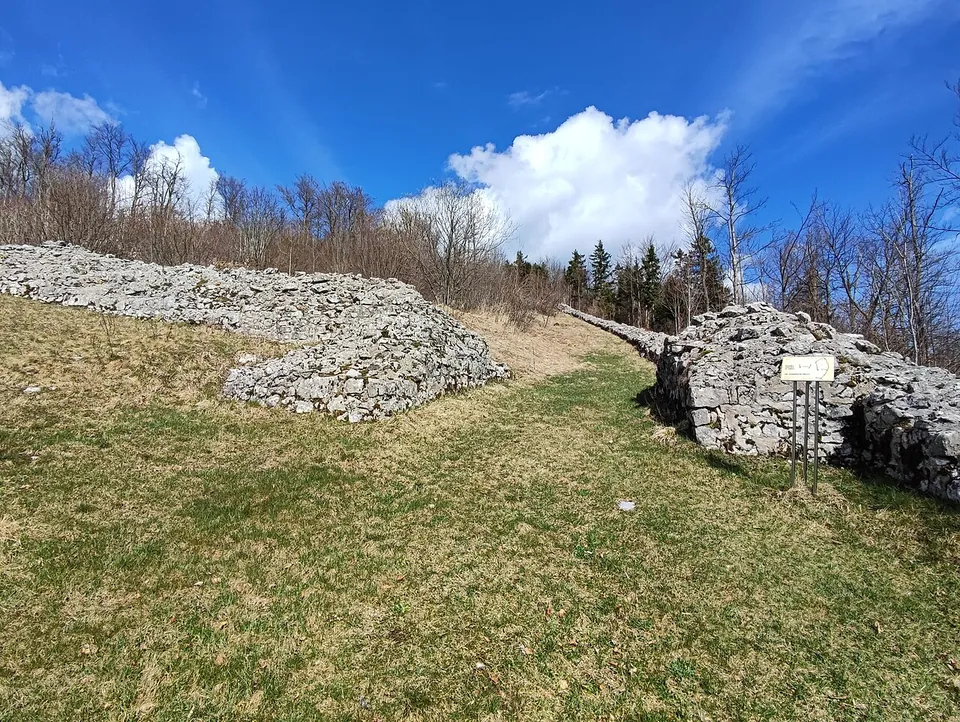
  • Two banks of piled pale limestone rubble, waist to head high, ending either side of a grassy gap, with a small information sign on a post and bare trees behind.

    Photo: Ajznponar · CC0 · Commons

    36 km · fort · Ajdovščina

    Ad Pirum

    The fort follows the ground in an irregular oval, 250 m long and up to 75 m wide.

Straight-line distances.

Sources

Every fact on this page comes from the records below, each used under the licence noted.
SourceLicence
Pleiades 197258CC BY
Wikidata Q148327CC0
Vici.org 1970CC BY-SA (text), CC0 (metadata)
OpenStreetMap relation/15464136ODbL
Wikipedia (en) — EmonaCC BY-SA 4.0
Wikipedia (sl) — EmonaCC BY-SA 4.0
MGML (Museum and Galleries of Ljubljana) — Arheopark Emona, the operator's pagelicence not recorded
MGML — City Museum of Ljubljana, hours and ticketslicence not recorded