
,_gate_to_the_northern_section.jpg)
,_SE_corner_of_the_fort.jpg)
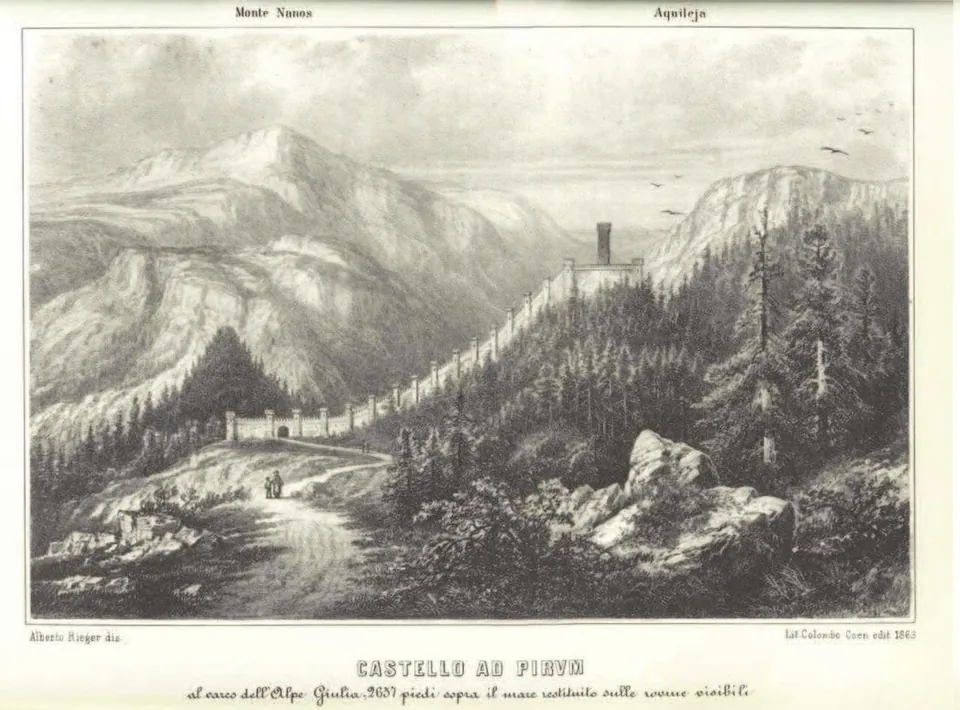
Ad Pirum was the most imposing fort of the Claustra Alpium Iuliarum (it.wikipedia), the late Roman wall system that closed the passes into Italy, and it sits right on the old Roman road from Aquileia to Emona where it crosses the Hrušica pass. What is left is the outline of the fort, a circuit of walls in forest and meadow.
What is there today
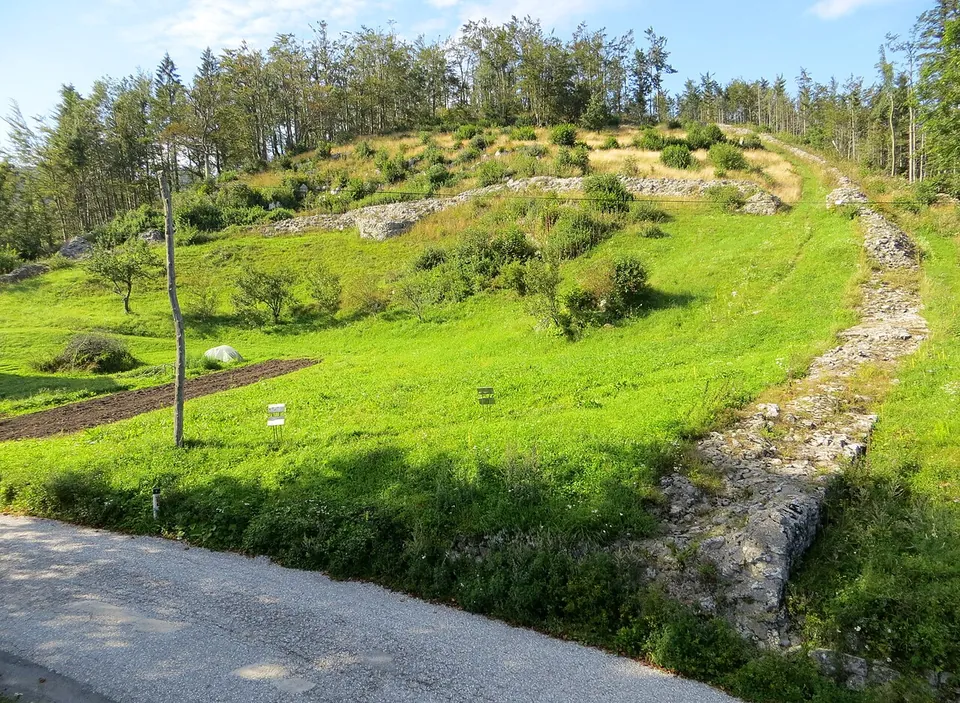
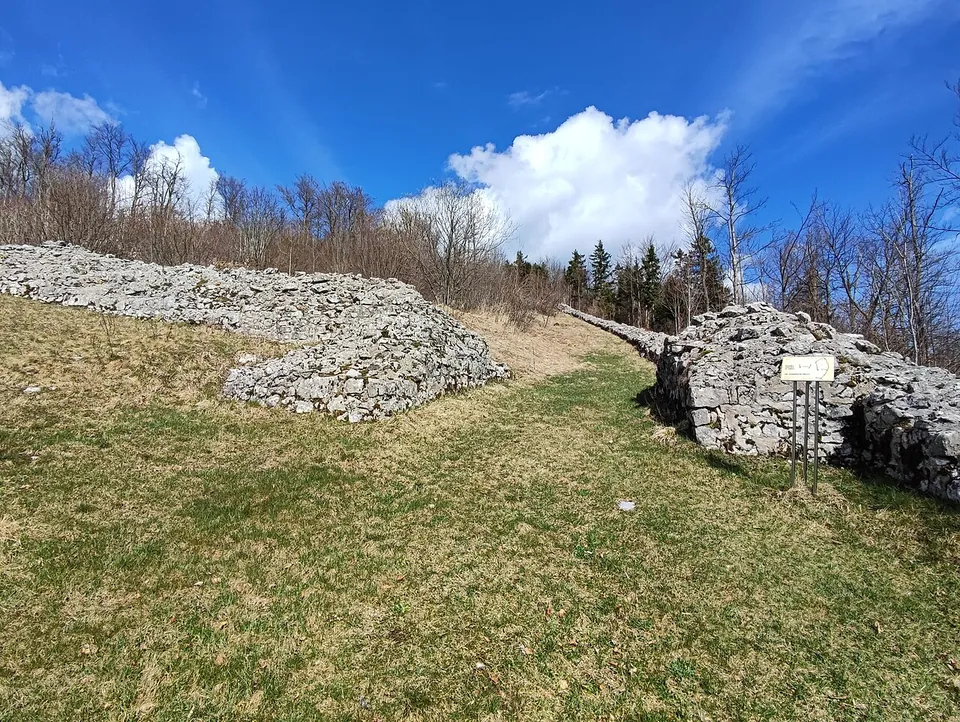
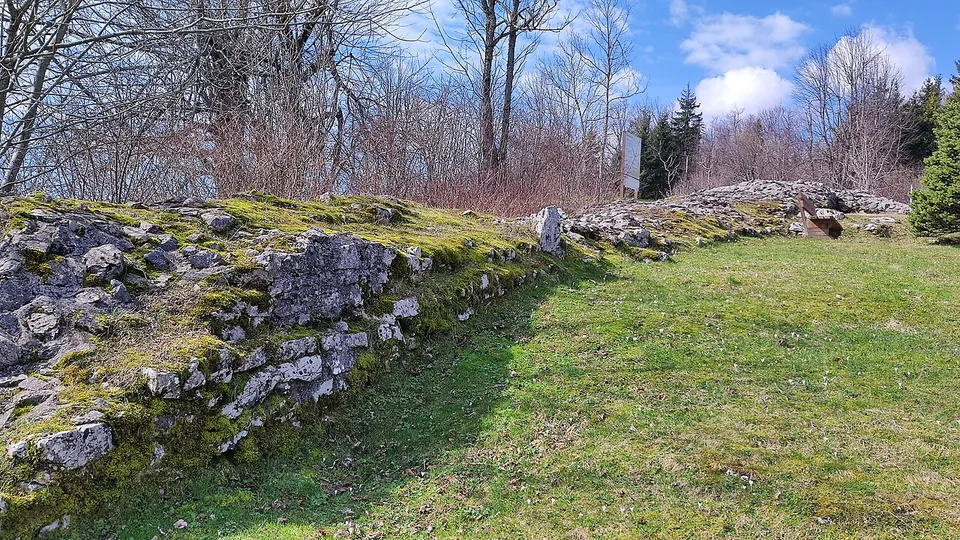
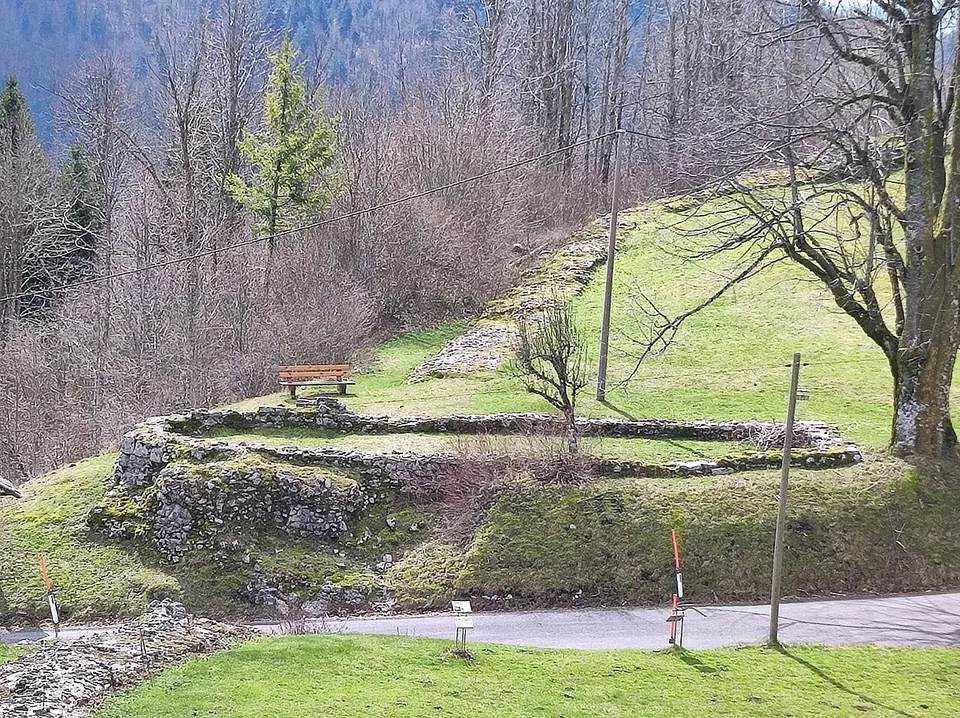
The fort follows the ground in an irregular oval, 250 m long and up to 75 m wide. Its wall was 2.7 m thick and originally about 8 m high, strengthened with towers; a cross wall with its own towers and a narrow gate divided it into a lower part, where the headquarters, barracks, workshops, the post station and a cistern stood, and an upper part used as a refuge and for grazing (National Museum of Slovenia). Today the walls stand as a low bank of pale limestone rubble that you can follow round the slope of Listnik, and the gate in the cross wall and the ruins of the southern tower can still be picked out. Inside the fort are the foundations of the medieval church of St Gertrude (heritage register).
The National Museum runs the site as an archaeological park, with a small exhibition on the fort and the whole Claustra system in the Stara pošta inn.
Is it worth the trip?
Yes, if the late Roman frontier interests you or you are driving between Ljubljana and Ajdovščina anyway: this is the main fort of what the museum calls the largest Roman-era monument in Slovenia, it is free, and you can walk it whenever you like. Be clear about what you will see. Nothing stands to its full height, and the towers and gates survive as footings, so the pleasure is in tracing a big fort on the ground in forest and meadow, not in looking up at walls.
Getting there
Hrušica is on the old road between Logatec and Ajdovščina. The museum gives the routes from Ljubljana via Logatec, Kalce and Podkraj, and from Ajdovščina via Col; both roads are cleared of snow in winter. You park at the Stara pošta inn, and the museum recommends walking boots. No bus stop is mapped nearby, so plan on a car.
The park is open at any time and costs nothing. The museum room in the inn opens Wednesday to Sunday — 11.00 to 19.00 midweek, from 10.00 on Saturday and from 09.00 on Sunday — and is also free. Guided tours for groups can be booked from April to October (National Museum of Slovenia, read 26 September 2026).
Two more Claustra forts are close by: Lanišče, 6 km by road towards Logatec, and Castra in the centre of Ajdovščina, 13 km the other way (the museum).
Visiting details
- Opening hours
- The archaeological park can be visited at any time. The museum room in the Stara pošta inn is open Wednesday to Friday 11.00–19.00, Saturday 10.00–19.00 and Sunday 09.00–19.00, and is closed on Mondays and Tuesdays.
- Tickets
- Free, for both the park and the museum room. Guided tours for groups run from April to October by arrangement (€5 a person for 10 or more, a flat €45 for up to 9); a public guided tour is €2.50.
- Parking
- At the Stara pošta inn, inside the park (the operator).
Before you go
- No public transport stop is mapped nearby; the site needs a car. The operator recommends walking boots.
Hours and prices checked 26 September 2026 on the operator's own site. Confirm before travelling.
History
Before there was a fort, the Romans built a post and relay station here, together with the state road of the Augustan period. The new road from Aquileia to Emona through Ajdovščina and over Hrušica replaced a longer route and saved a day’s travel between the two towns; from the 2nd century a beneficiarius post, a kind of police station, stood here as well (National Museum of Slovenia).
The fort came when raids across the frontier shook the long peace. Published dates differ: the museum puts it in the late 3rd century, while the English Wikipedia article, citing Peter Kos (2014), says the 320s. Either way it belonged to the Claustra Alpium Iuliarum, more than 80 km of walls, towers and forts begun in the second half of the 3rd century and fully in operation in the Constantinian period, the first half of the 4th century. Around 500 soldiers — a cohort — could be quartered here, and the road ran straight through the fort between two gates with towers probably 10 m high (the museum).
The fort was abandoned in the 5th century, though traffic on the road continued until at least the end of the 6th. Between the 12th and 14th centuries a church of St Gertrude, patron of travellers, was built inside the ruins, and a regular post service between Gorizia and Ljubljana used the old road until the middle of the 19th century; the building of today’s inn was its post station (National Museum of Slovenia).
More photographs
,_ruins_of_the_St._Gertrude_church_01.jpg)
.jpg)
Nearby
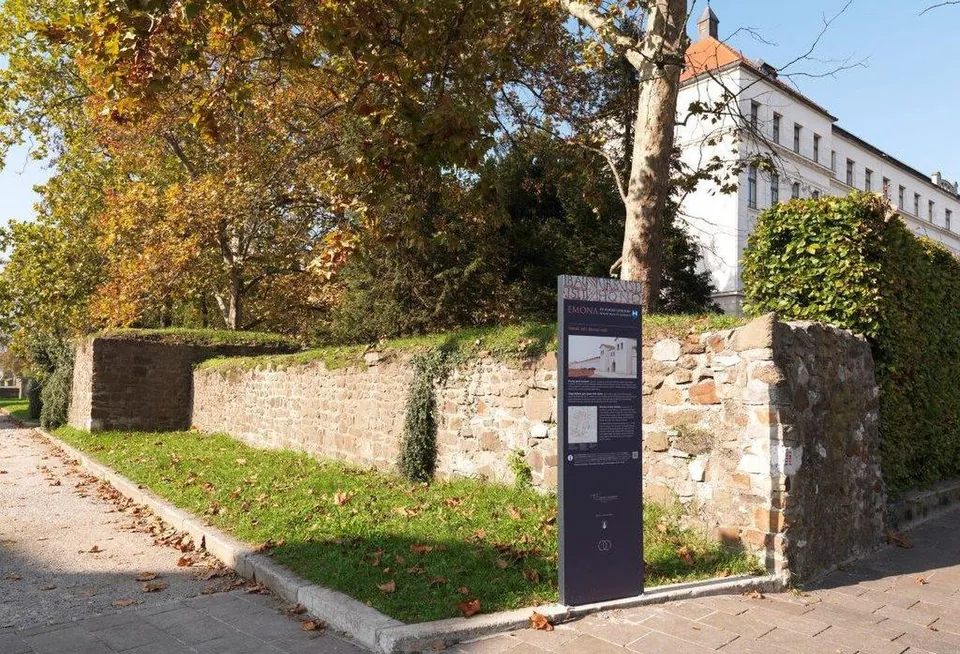
Photo: Matevž Paternoster, dokumentacija Muzeja in galerij mesta Ljubljane · CC BY-SA 3.0 · Commons
36 km · wall · Ljubljana
Roman Walls in Mirje
A long wall of rubble stone, grassed along the top, with square towers projecting from it, runs through a park between Aškerčeva cesta and the street Mirje, from the junction with Barjanska cesta to the junction with Snežniška ulica.
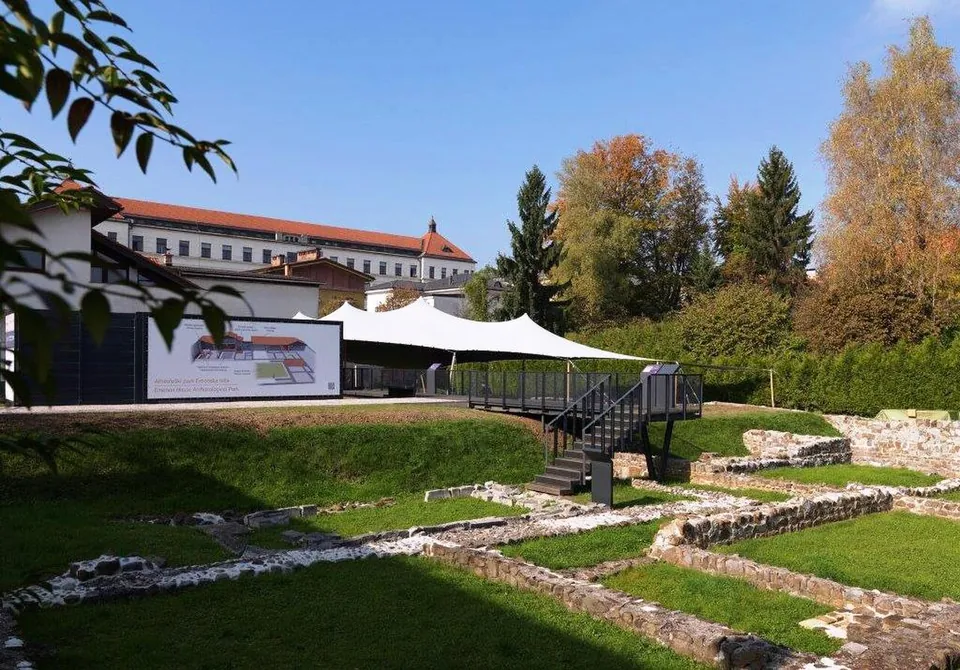
Photo: Matevž Paternoster, dokumentacija Muzeja in galerij mesta Ljubljane · CC BY-SA 3.0 · Commons
36 km · city · Ljubljana
Emona – Ljubljana
The best of it is in two small archaeological parks run by the city museum (MGML).
.jpg)
.jpg)
Straight-line distances.
Sources
Every fact on this page comes from the records below, each used under the licence noted.
| Source | Licence |
|---|---|
| Pleiades 197317 | CC BY |
| Wikidata Q4678175 | CC0 |
| OpenStreetMap node/1883524819 | ODbL |
| Narodni muzej Slovenije — Arheološki park Ad Pirum (the operator; hours, prices, directions) | licence not recorded |
| Narodni muzej Slovenije — Ad Pirum, history | licence not recorded |
| Register nepremične kulturne dediščine, unit 535 (Ministrstvo za kulturo RS, CC BY 4.0) | licence not recorded |
| Wikipedia (en) — Ad Pirum | CC BY-SA 4.0 |
| Wikipedia (it) — Ad Pirum | CC BY-SA 4.0 |