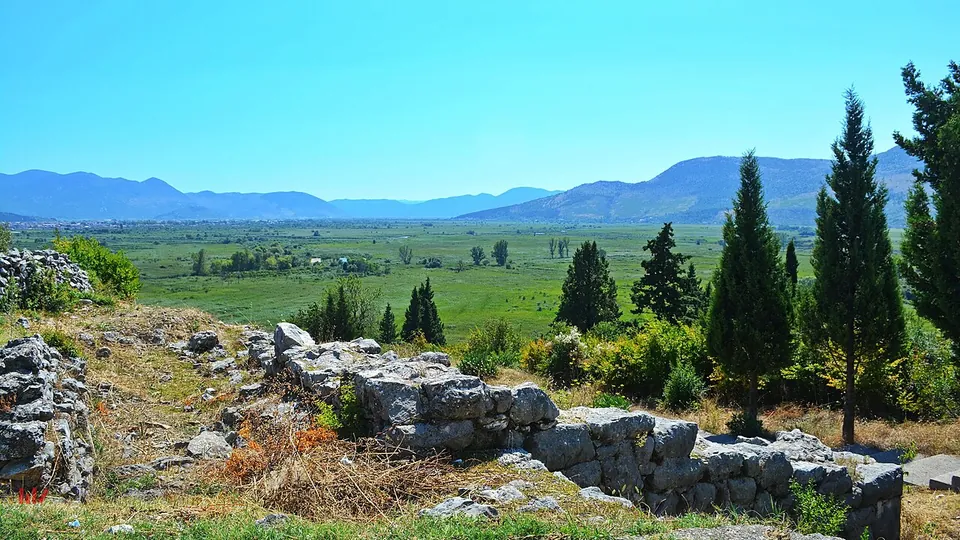
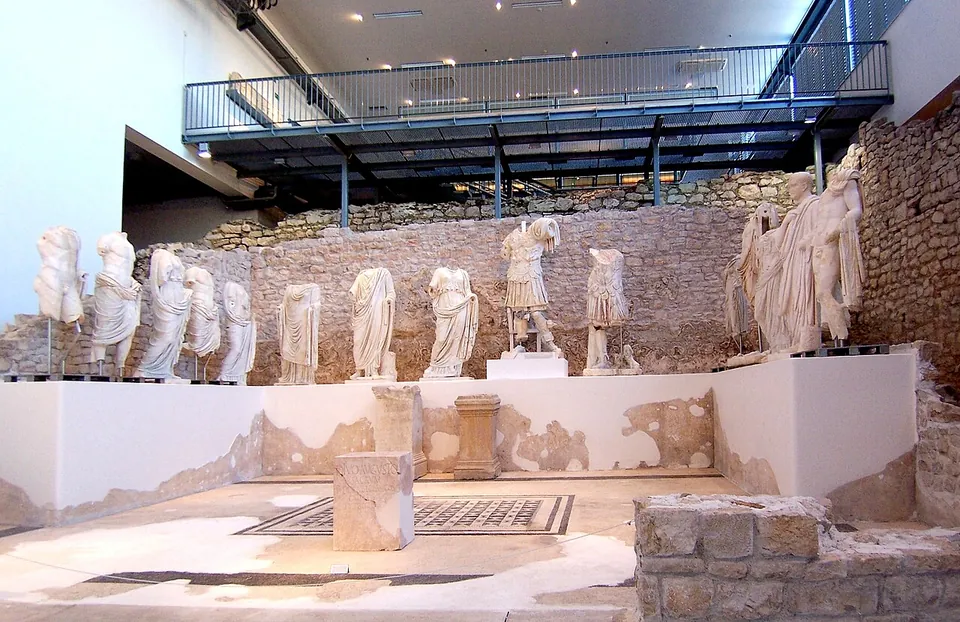
Narona was a Greek trading post that became a major Roman town in the Neretva valley, at today’s village of Vid near Metković. Its highlight is unusual: a museum built right over the town’s temple of Augustus, where the statues of the imperial family found in the temple stand in the room they were found in.
What is there today
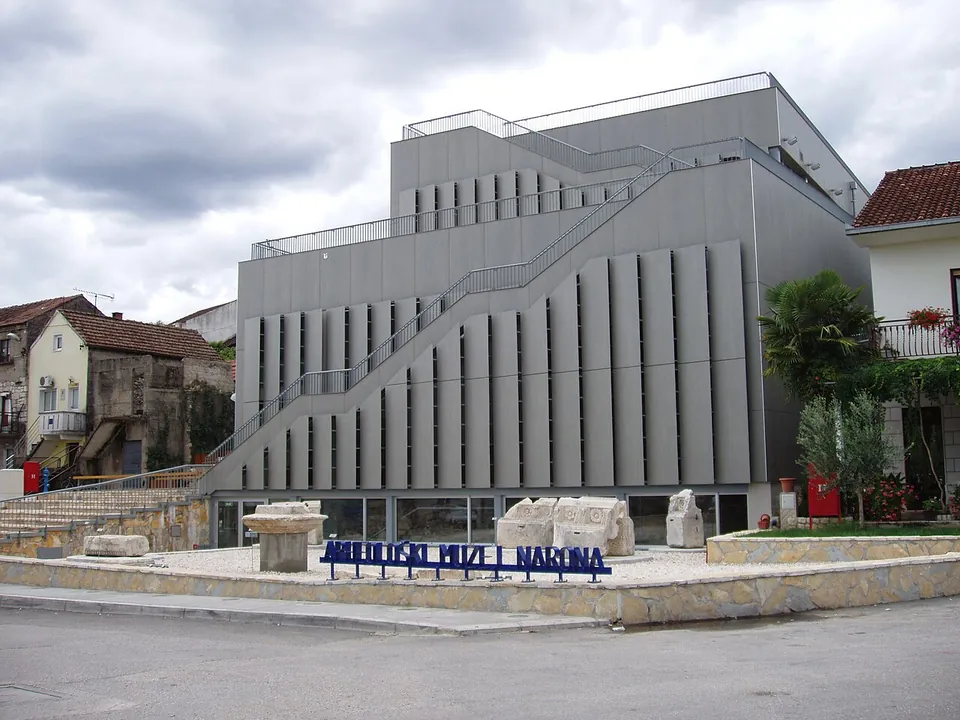
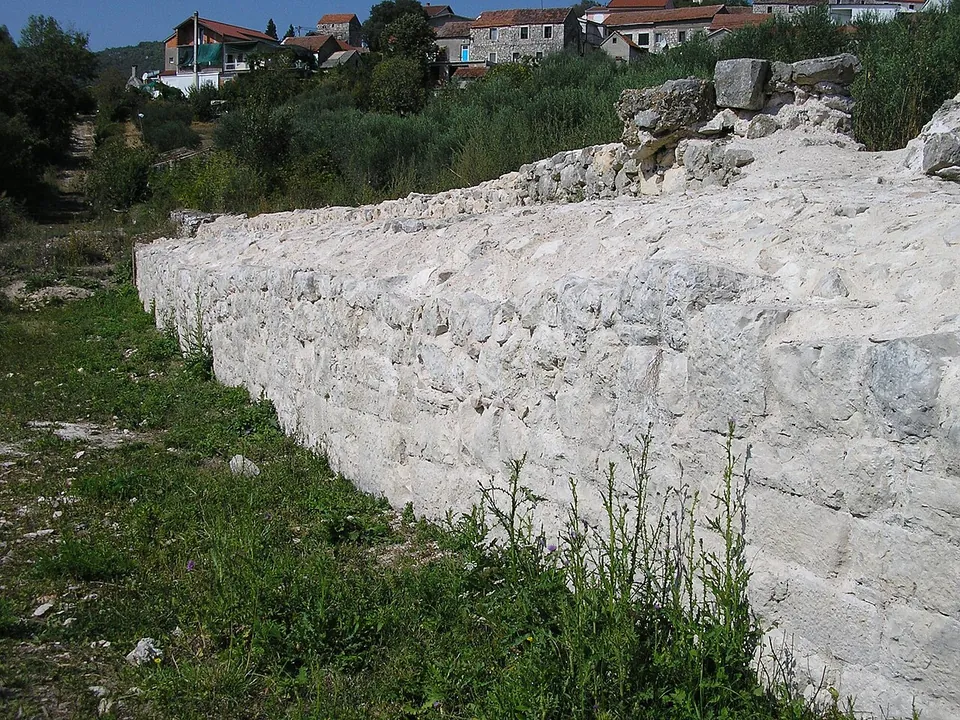
The Narona Archaeological Museum was the first museum in Croatia built in situ, over the remains of the Augusteum, the temple of the emperor Augustus (hr.wikipedia). In its main hall, on the site of the temple, stand the statues of emperors and members of their families found there in 1995–96 — at least 19 statues, 16 of them emperors and relatives — together with the temple’s mosaic. Around it some 900 finds from Narona are on show, and outside, on terraces reached by stairs, are architectural fragments, inscriptions and a mosaic under a glass floor that probably belonged to a Roman shop (hr.wikipedia). The temple had been dedicated by the governor Dolabella; its statues were vandalised in the 4th century and their heads knocked off, and two heads bought nearby by Arthur Evans in 1878 have since been reunited with their bodies (en.wikipedia). Stretches of the city walls and other excavated sites lie around the village.
Is it worth the trip?
Yes, for the museum: a room full of imperial statues standing where they were found. The rest of Narona is scattered remains, so the museum is the reason to come.
Getting there
The museum is in Vid, about 4 km from Metković (the nearest town, OpenStreetMap). From June to September it is open Tuesday to Sunday, 09.00 to 19.00; from October to May, Tuesday to Friday 09.00–16.00, Saturday 09.00–17.00 and Sunday 09.00–13.00; it is closed on Mondays and holidays. A ticket is €6, or €3 for pupils, students and pensioners, and a family ticket €14. Guided tours can be booked in Croatian or English (Narona Archaeological Museum, read 26 September 2026). The outdoor terraces can be walked even when the museum is closed (hr.wikipedia).
Visiting details
- Opening hours
- From 1 June to 30 September, Tuesday to Sunday 09.00–19.00. From 1 October to 31 May, Tuesday to Friday 09.00–16.00, Saturday 09.00–17.00, Sunday 09.00–13.00. Closed on Mondays and public holidays. Booked groups can visit outside these hours.
- Tickets
- €6; €3 for pupils, students and pensioners; €14 for a family; €4 a head for groups. Guided tours by booking, €25 in Croatian or €30 in English.
Before you go
- The outdoor terraces with larger stone pieces can be walked even outside opening hours (hr.wikipedia).
Hours and prices checked 26 September 2026 on the operator's own site. Confirm before travelling.
History
Narona began as a Greek emporium in the 3rd or 2nd century BC and became the major Roman stronghold of the region in the 1st century BC, in the province of Dalmatia. It came under Byzantine rule in the 6th century, when it was a bishopric (from 530); the see was suppressed in 600 because the city was ruined, and the settlement ended in the 7th century with the arrival of the Slavs (en.wikipedia). The first known excavations were in 1877, and the great discovery of the Augusteum and its statues came in 1995–96; the museum opened on 18 May 2007 (hr.wikipedia).
More photographs
Nearby
6 km · villa · Čapljina
Mogorjelo
The 4th-century compound measures 102 by 86 m, with a tower at each corner — three square and one, the eastern, round — and gates on three sides, the north gate once flanked by carved blocks with acanthus and vine.
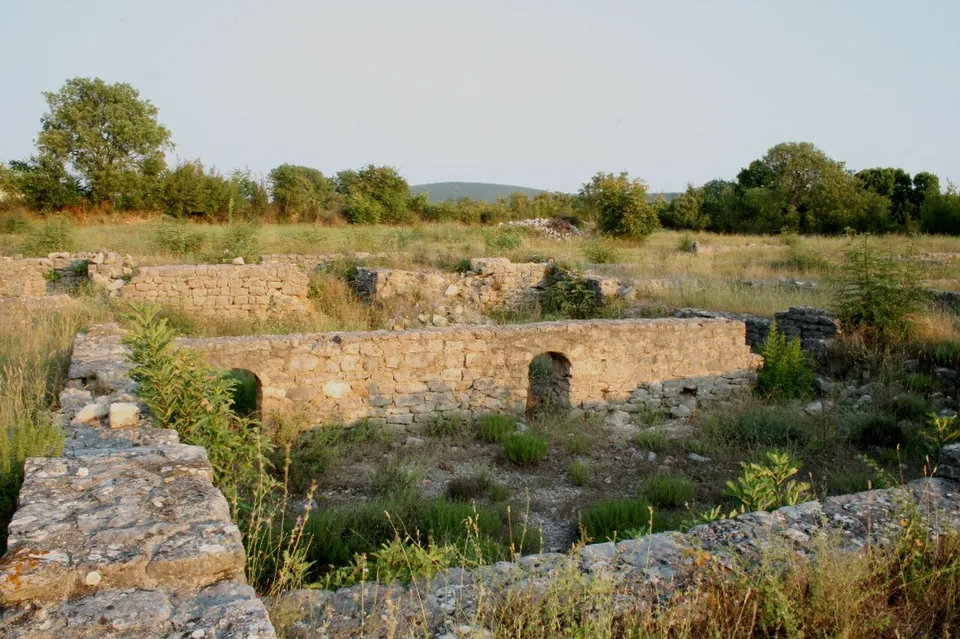
Photo: Croromano · CC BY-SA 3.0 · Commons
14 km · fort · Ljubuški
Castra of Gračine
The site covers about 4 hectares, of which the walled complex took about 1.5; its wall, about 0.9 m thick, ran 140 m north to south and 110 m east to west (hr.wikipedia).
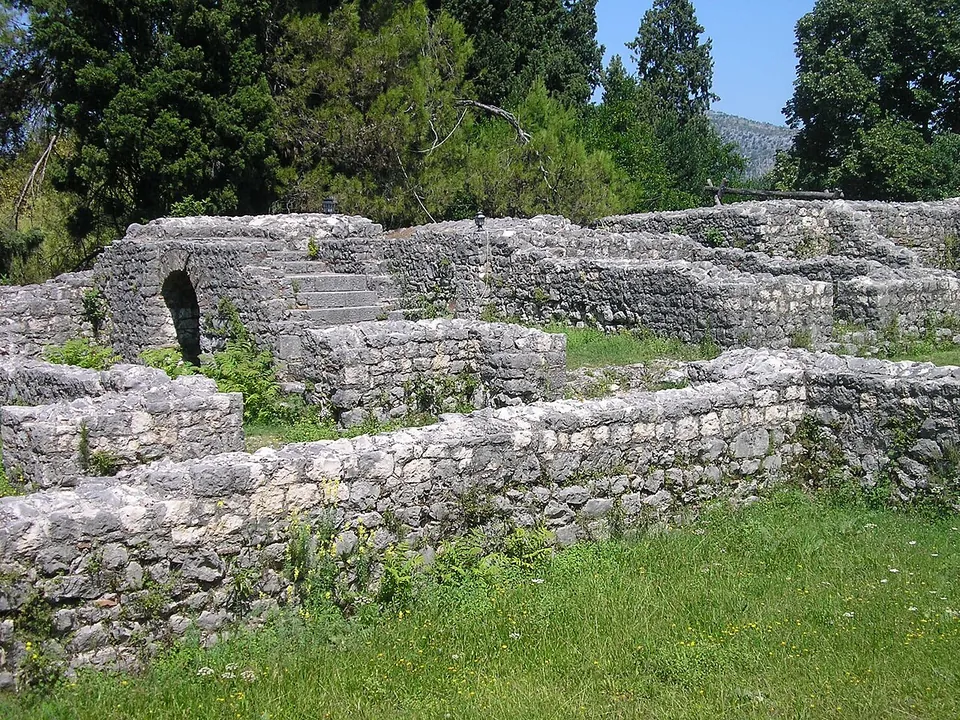
.jpg)


.jpg)
.JPG)

Straight-line distances.
Sources
Every fact on this page comes from the records below, each used under the licence noted.
| Source | Licence |
|---|---|
| Pleiades 197400 | CC BY |
| Wikidata Q1965337 | CC0 |
| OpenStreetMap way/182879558 | ODbL |
| Wikipedia (en) — Narona | CC BY-SA 4.0 |
| Wikipedia (hr) — Arheološki muzej Narona | CC BY-SA 4.0 |
| Arheološki muzej Narona — opening hours and prices (the operator) | licence not recorded |