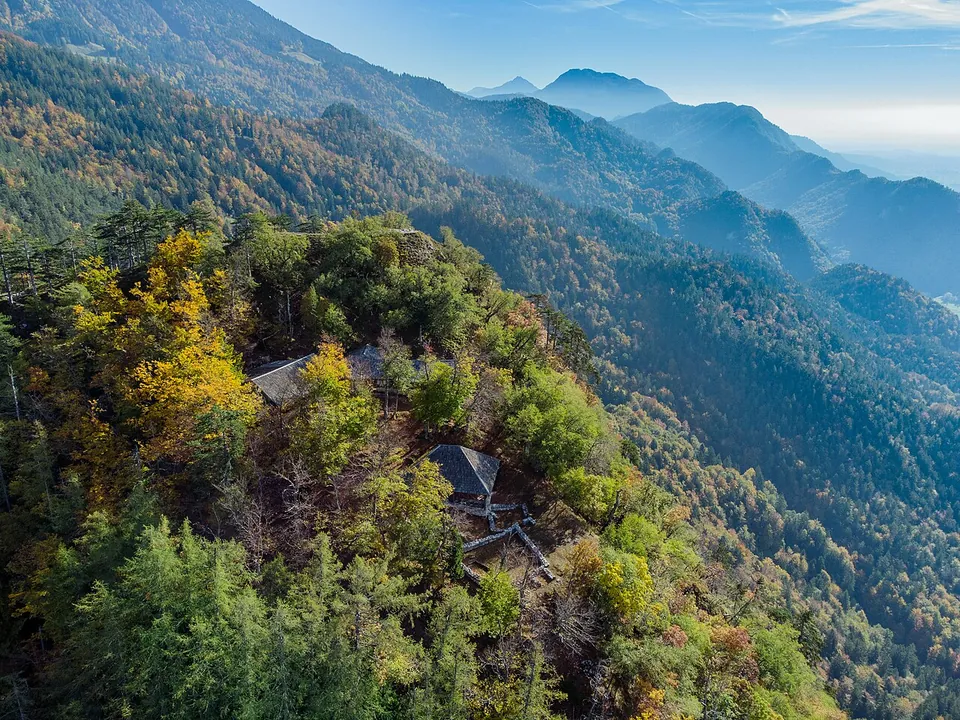
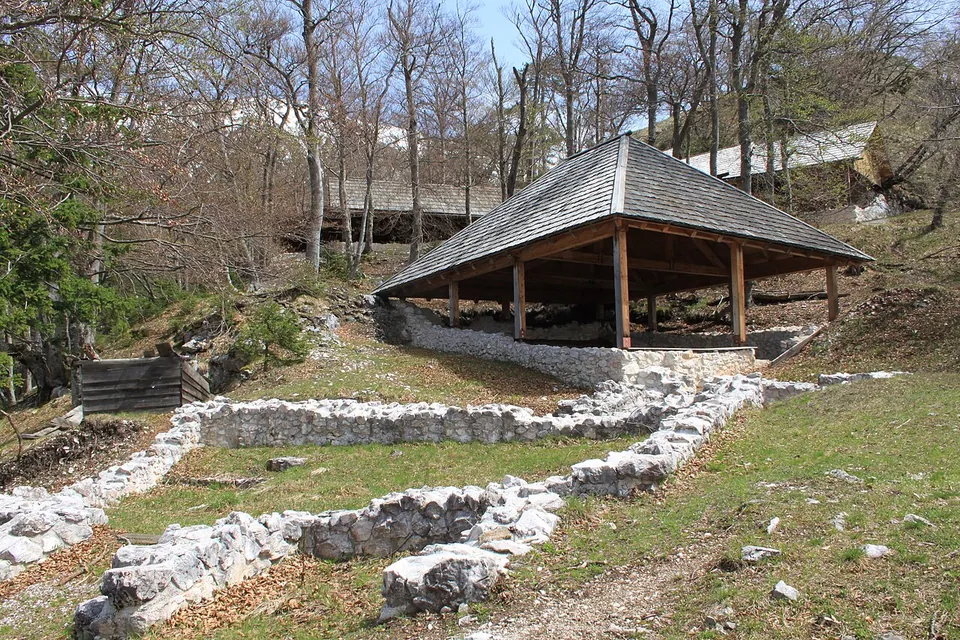
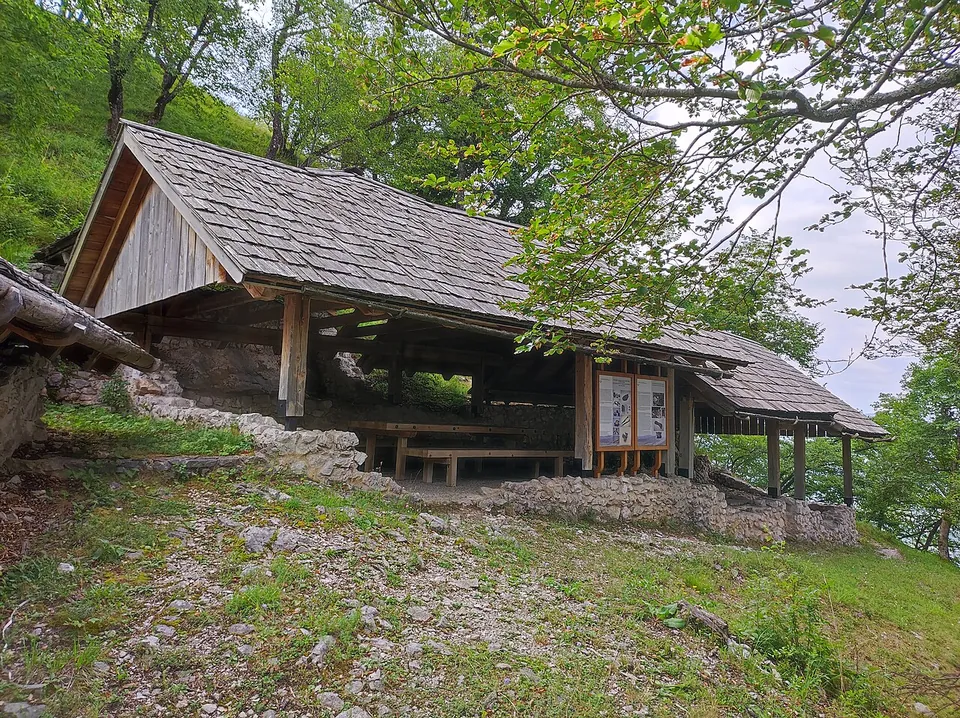


Ajdna is a late antique refuge village on a rock tooth high on the southern slope of Mt Stol, where people from the valley below retreated in the 5th and 6th centuries. You climb to it on foot and find the stone footings of its houses and church under wooden shelters, with a view over the Upper Sava valley towards the Julian Alps and Lake Bled.
What is there today
The settlement was built on terraces just below the summit (the register says three; sl.wikipedia two, joined by a ridge). An early Christian church took the central place, with about 25 houses around it and two water cisterns; the church and five of the houses have been conserved and are shown under shingle-roofed shelters, with information boards (heritage register; en.wikipedia). The church had a nave for the congregation and a space for the clergy, a porch added at the entrance and later a small two-roomed annex on the north side, perhaps a baptistery. The houses were partly cut into the rock (sl.wikipedia).
Is it worth the trip?
Yes, if you like a hike with a destination. This is the highest of Slovenia’s late antique hilltop settlements, and the setting is the point: a cliff-edge village looking out over the Upper Sava valley, with remains laid out clearly enough to read the houses and church. It is not a site for anyone who cannot manage a steep path, and there is nothing to buy or visit at the top. The objects found here — pottery, jewellery, weapons — are down in the valley: in the Gorenjska Museum in Kranj, and in a small museum room in Žirovnica.
Getting there
Ajdna rises above the village of Potoki near Žirovnica, between Radovljica and Jesenice. From Potoki it is a steep walk of about an hour to the top; a shorter way is to drive from Žirovnica towards Potoška planina as far as the Ajdna turn-off, from where the summit is about 15 minutes on foot. The regional tourist board points drivers to the car park by the lake in the Završnica valley, which has been paid since 2020, and notes that Žirovnica has a bus and train connection on the Ljubljana–Jesenice line (Julian Alps tourist board). The upper part of every approach is steep (sl.wikipedia).
The site itself is free and open at any time. The Ajdna museum room in Čop’s birth house in Žirovnica shows original finds and copies; it opens on weekdays, 08.00 to 15.00 with a break at 11.00, from September to June, and every day except Monday in July and August, and costs €3 (Visit Žirovnica, read 26 September 2026).
Visiting details
- Opening hours
- The site is open ground, reachable at any time on foot. The Ajdna museum room in Čop's birth house in Žirovnica is open September to June Monday to Friday 08.00–11.00 and 12.00–15.00 (closed at weekends and on holidays), and in July and August Tuesday to Friday 09.00–16.00 and at weekends 10.00–17.00.
- Tickets
- The site is free. The museum room is €3 for adults, €2.80 for seniors, €2.50 for schoolchildren and €1 for pre-school children.
- Parking
- The regional tourist board directs drivers to the car park by the lake in the Završnica valley, which has charged since 2020; the shorter approach starts from the road towards Potoška planina.
- On foot
- About 60 min from the parking
Before you go
- It is a steep climb on foot. From the village of Potoki it takes about an hour; from the Ajdna turn-off on the road to Potoška planina about 15 minutes. The upper part of every approach is steep.
- The finds are not on the hill. They are in the Gorenjska Museum in Kranj and in the museum room in Žirovnica.
Hours and prices checked 26 September 2026 on the operator's own site. Confirm before travelling.
History
A stone axe dates the first people on the summit to the 3rd or 2nd millennium BC; the hill was settled again in late antiquity (sl.wikipedia). A few objects from the early Roman Empire, among them a small bronze buckle in the shape of a bird, suggest there were dwellings on the rock even then (Visit Žirovnica). The village was at its height in the 5th and 6th centuries, after the collapse of the Western Empire, when valley people used it as a refuge from the Germanic and Slavic peoples moving through the region. The finds show they farmed, kept livestock and worked iron; Germanic pottery and an Ostrogothic silver coin of 534–536 show contact with the newcomers. Eleven graves were found inside the church, but the settlement’s real cemetery has not been located. The village was abandoned in the second half or at the end of the 6th century (sl.wikipedia).
In the 9th century the rock was occupied again: spurs, knife fittings and belt buckles of Frankish and Slavic military equipment were found (sl.wikipedia). The tourist board thinks it most likely that they belonged to rebels from the rising of Ljudevit Posavski against the Franks in 820, who made their last stand here.
Excavations began in the 1970s — 1973 according to sl.wikipedia, 1976 according to en.wikipedia and the tourist board — first under Andrej Valič, and later under the Institute for the Protection of Monuments in Kranj led by Milan Sagadin; the last took place between 1999 and 2004 (Visit Žirovnica). The site was declared a monument of national importance in 2011 (sl.wikipedia).
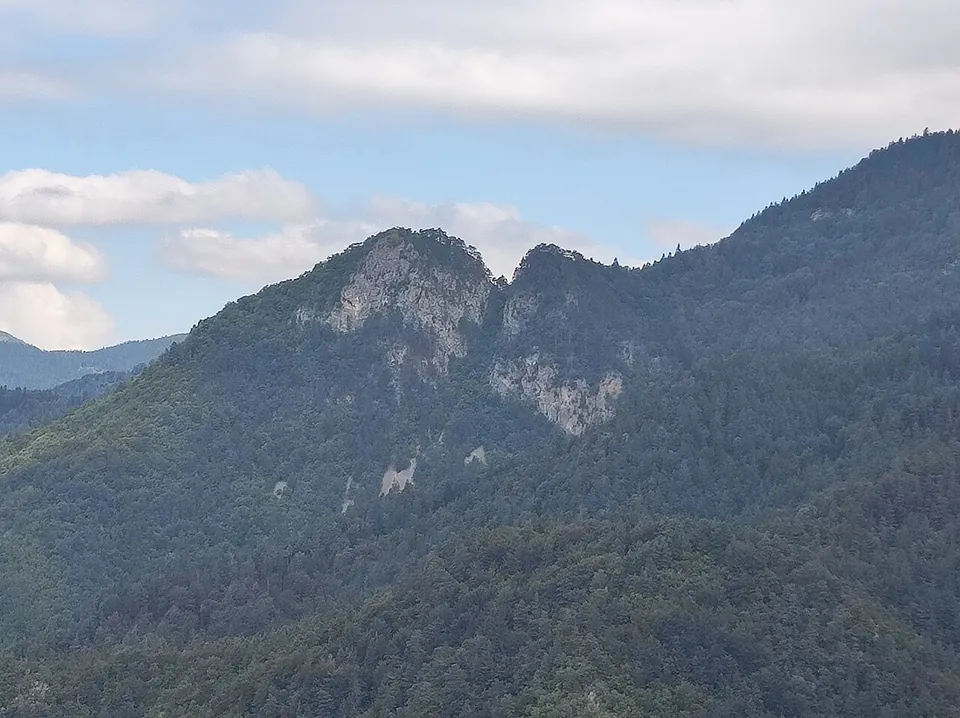
More photographs

Nearby
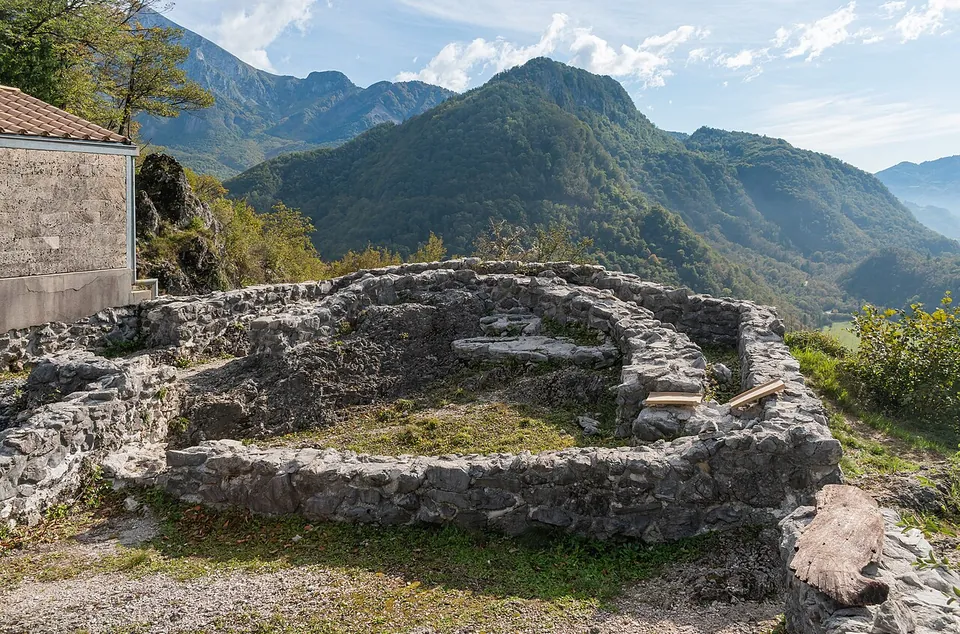
Photo: Krzysztof Golik · CC BY-SA 4.0 · Commons
46 km · fort · Kobarid
Tonovcov grad
The settlement of the second half of the 5th and the 6th centuries was about 150 m long and 90 to 120 m wide — published figures differ (sl.wikipedia; the Tolmin museum) — inside a double defensive wall, with many stone houses and four early Christian churches (the Tolmin museum).
.jpg)
Straight-line distances.
Sources
Every fact on this page comes from the records below, each used under the licence noted.
| Source | Licence |
|---|---|
| Wikidata Q2828861 | CC0 |
| OpenStreetMap node/5747564021 | ODbL |
| Register nepremične kulturne dediščine, unit 564 (Ministrstvo za kulturo RS, CC BY 4.0) | licence not recorded |
| Wikipedia (en) — Ajdna | CC BY-SA 4.0 |
| Wikipedia (sl) — Ajdna | CC BY-SA 4.0 |
| Visit Žirovnica — Archaeological site Ajdna | licence not recorded |
| Visit Žirovnica — Ajdna museum room (hours and prices) | licence not recorded |
| Julijske Alpe (Julian Alps regional tourist board) — Arheološko najdišče Ajdna nad Potoki | licence not recorded |