,_Burnum_legionary_camp,_Dalmatia_(10379341445).jpg)
,_Burnum_legionary_camp,_Dalmatia_(10379394316).jpg)

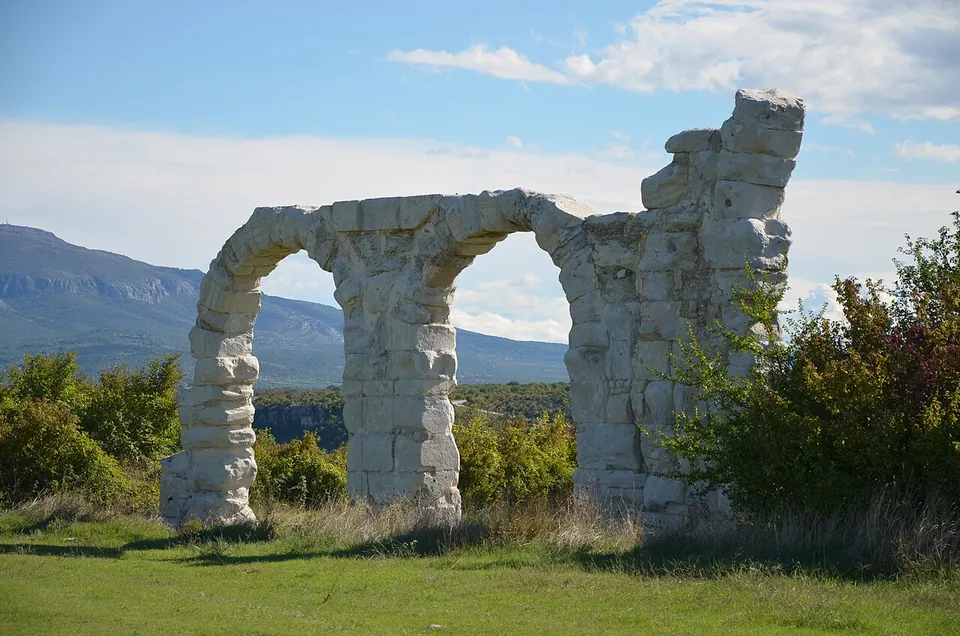
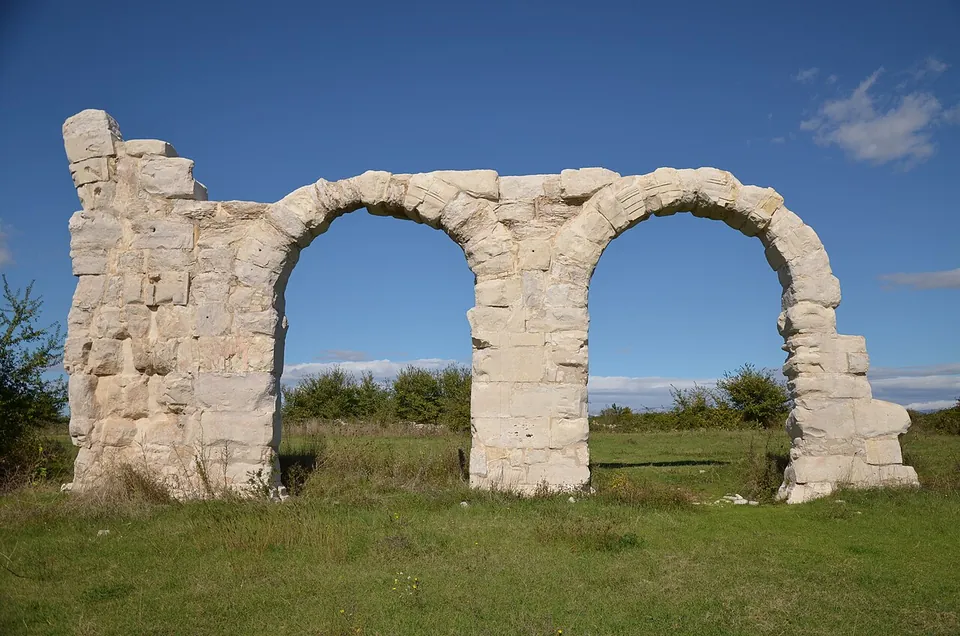
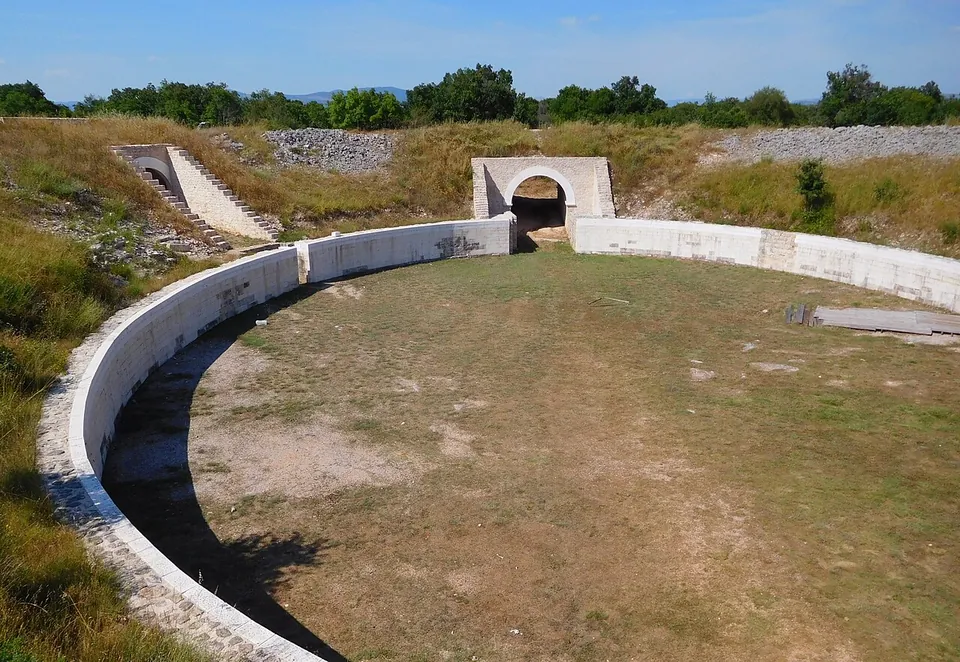
Burnum was a Roman legionary fortress on the river Krka, built under Augustus to control traffic along the river, and later a Roman town. Two tall arches of its headquarters building still stand alone in the fields above the Krka canyon, and nearby is the only Roman military amphitheatre preserved in Croatia.
What is there today
The site is in two parts, both inside Krka National Park. On the road from Knin to Zadar, at Ivoševci, stand the two arches of the principia, the fortress headquarters, known locally as Šuplja crkva, the “Hollow Church”; behind them opens the gorge of the Krka (hr.wikipedia). The principia was the fortress’s administrative and religious centre where its two main streets crossed; completed under Tiberius, it was enlarged after the rebellion of 42 to about 104 by 73 m, and under Hadrian it was turned into the civil basilica of the town (en.wikipedia). Traces of the ramparts and of a smaller training camp can be seen too (en.wikipedia; the park).
The amphitheatre
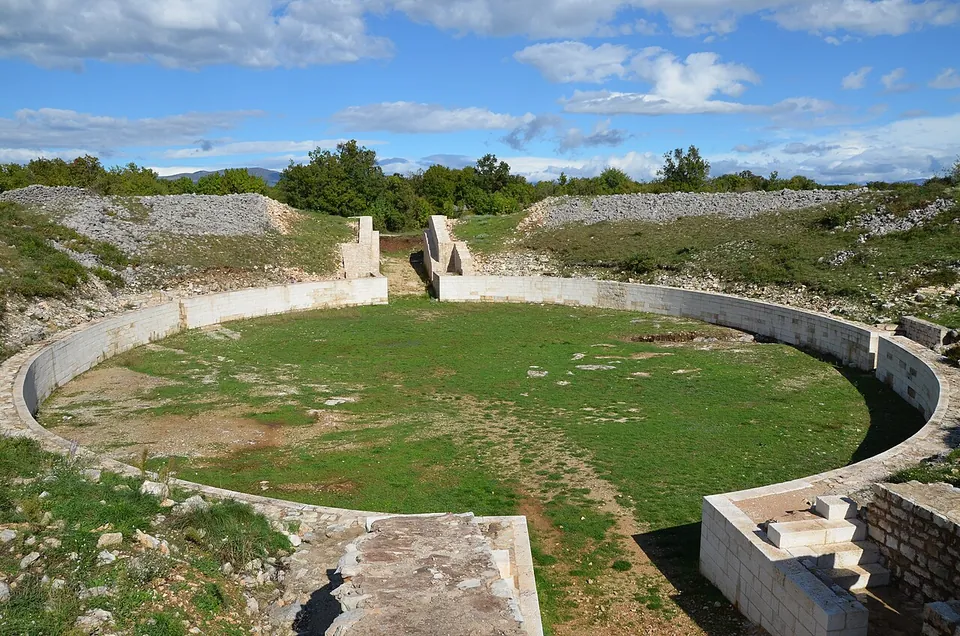
About 1 km south-west of the arches, on the other side of the road, lies the amphitheatre (hr.wikipedia). It was cut into the bedrock by soldiers of the Eleventh Legion, had four entrances and held an estimated 6,000 spectators; coins date parts of it to the reign of Claudius, and it later passed to civilian use (en.wikipedia). The park calls it the only preserved Roman military amphitheatre in Croatia.
Is it worth the trip?
Yes, if you are visiting the upper Krka anyway: the arches stand alone in open country above the canyon, and the amphitheatre is a rarity. On its own it is a long drive for two monuments, so treat it as part of a day on the upper Krka — the same ticket covers the Manojlovac waterfall and the collection of finds at the Eco Campus in Puljane.
Getting there
Burnum is at Ivoševci, 19 km from Knin on the road to Kistanje and Zadar (hr.wikipedia), and can only be reached by road (the park). It is open all year. The park lists it with the Manojlovac waterfall: in September from 08.00 to 19.00, though a footnote moves Manojlovac to 09.00–17.00 from 21 September without saying whether Burnum follows; in October 09.00–17.00; in winter 09.00–16.00. The ticket, which also covers Roški slap, Manojlovac, Kistanje and the Krka Eco Campus, is €20 for adults from June to September, €12 in April, May and October and €7 in winter, with lower prices for children and students and free entry under seven. A guide at the site costs €30 for the first hour (Krka National Park, read 26 September 2026).
Visiting details
- Opening hours
- Open all year. The park lists Burnum with the Manojlovac waterfall — 08.00–19.00 in September (a footnote moves Manojlovac to 09.00–17.00 from 21 September; whether Burnum follows is not stated), 09.00–17.00 in October, 09.00–16.00 from November to February, 09.00–17.00 in March, 10.00–18.00 or later from April to August.
- Tickets
- The park ticket for Roški slap, Manojlovac, Burnum, Kistanje and the Krka Eco Campus is €20 for adults from June to September, €12 in April, May and October and €7 from November to March; children aged 7–18 and students pay €12, €8 and €4; free under 7. A guide at the site is €30 for the first hour.
Before you go
- Burnum can only be reached by road (the park); there is no public transport or car park mapped at the arches.
- The finds are in the Burnum Archaeological Collection at the Krka Eco Campus in Puljane, on the same ticket.
Hours and prices checked 26 September 2026 on the operator's own site. Confirm before travelling.
History
Pliny the Elder names Burnum among the forts “distinguished in battles”. The name belonged first to a native hillfort on the left bank of the Krka at Puljane, opposite the later camp (hr.wikipedia). The Twentieth Legion was stationed here until the Pannonian-Illyrian revolt of AD 6–9; when it moved to Germany it was replaced by the Eleventh, which probably began the permanent fortress soon after arriving; under Claudius the camp took its final form, and an aqueduct 32.6 km long brought water from Plavno polje. The Eleventh left in 69 and the Fourth Flavia Felix followed from 70 until 86, when it moved to Singidunum (Belgrade) (hr.wikipedia; en.wikipedia gives slightly different dates for the changeovers).
With the legions gone, Burnum grew into a town; it was a municipium by 118, under Hadrian. Procopius last mentions it during Justinian’s war with the Goths, who took refuge there after a defeat in 537 and repaired the old walls; by the time of the Avar raids of the early 7th century, life at Burnum had come to an end (hr.wikipedia).
More photographs
.jpg)
Nearby
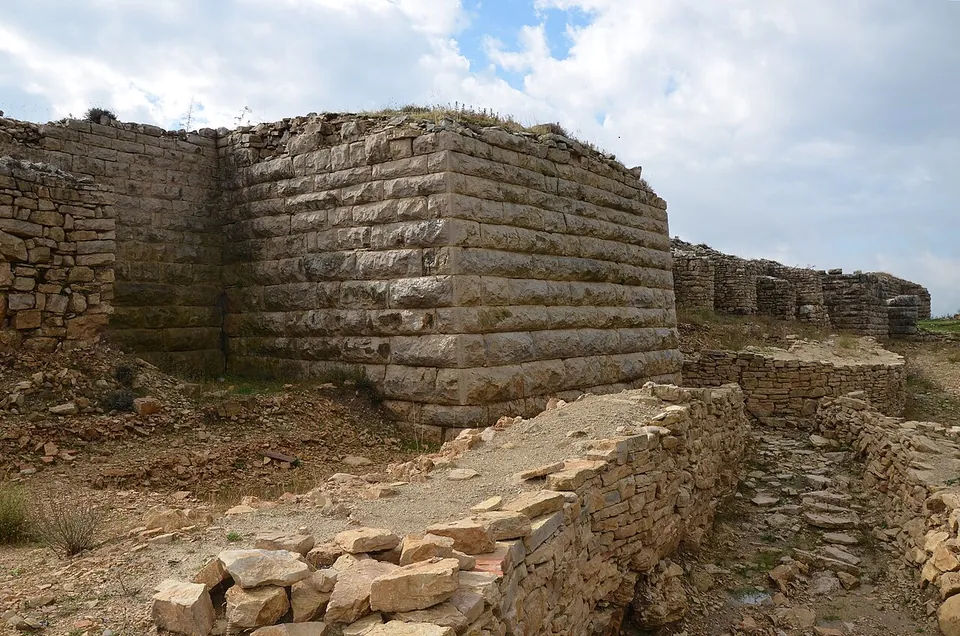
Photo: Carole Raddato · CC BY-SA 2.0 · Commons
29 km · city · Zadar County
Asseria
Long stretches of the city wall survive, in courses of massive squared blocks, with corner towers; English Wikipedia says the ashlar walls predate the Roman occupation, while German Wikipedia says the monumental late antique walls largely replaced the earlier Roman and Liburnian defences.
.jpg)
Straight-line distances.
Sources
Every fact on this page comes from the records below, each used under the licence noted.
| Source | Licence |
|---|---|
| Pleiades 197184 | CC BY |
| Wikidata Q548862 | CC0 |
| OpenStreetMap way/250691946 | ODbL |
| Wikipedia (en) — Burnum | CC BY-SA 4.0 |
| Wikipedia (hr) — Burnum | CC BY-SA 4.0 |
| Krka National Park — Burnum/Puljane entrance (the operator) | licence not recorded |
| Krka National Park — working hours | licence not recorded |
| Krka National Park — price list 2026 (PDF) | licence not recorded |