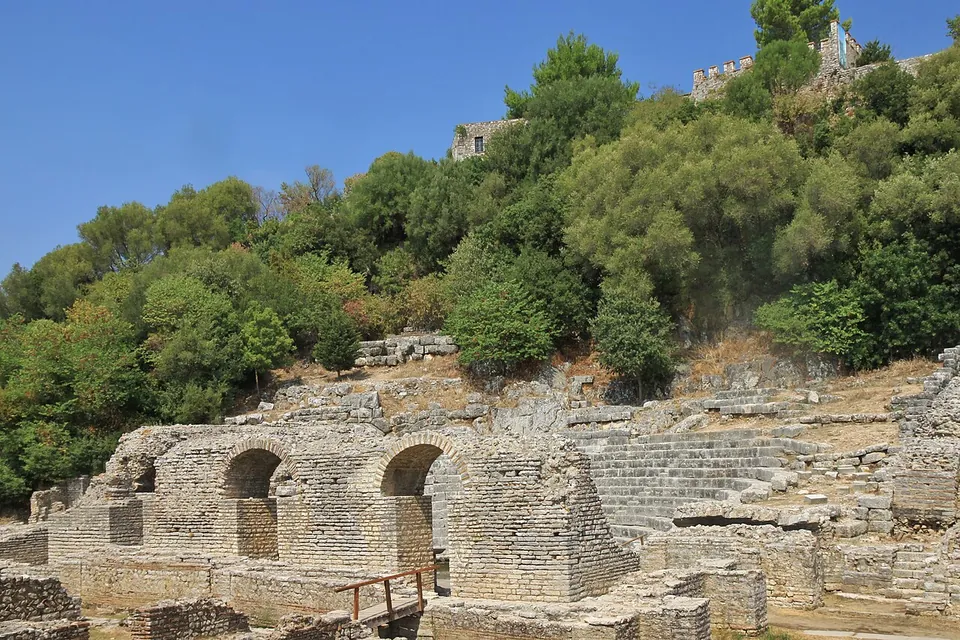
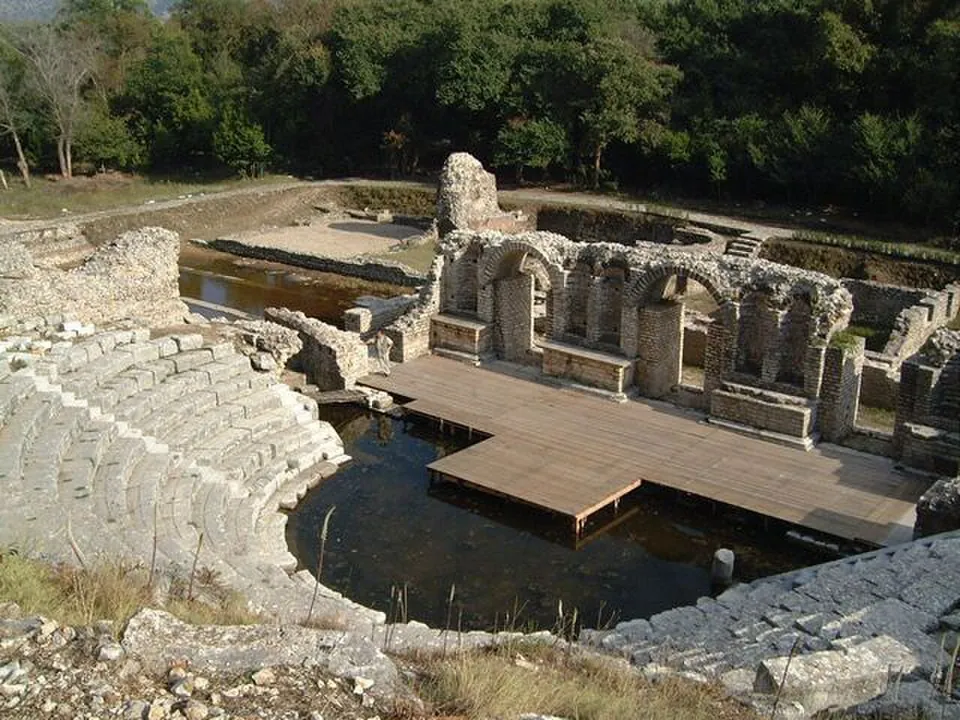


Butrint is an ancient city on a wooded peninsula in the far south of Albania, a Greek town that became a Roman colony and later a Byzantine bishopric, and it is considered one of the most important archaeological sites in Albania (en.wikipedia): theatre, baths, temples, a baptistery, basilicas and city walls, all inside a national park by a lagoon. It has been a UNESCO World Heritage Site since 1992.
What is there today
The city spreads across the peninsula below the acropolis hill; the site museum is housed in the Venetian castle on the acropolis (en.wikipedia, Archaeological Museum). Within the park are the city walls, the late-antique baptistery, a great basilica, the theatre and two castles (en.wikipedia, National Park).
The theatre and the sanctuary of Asclepius
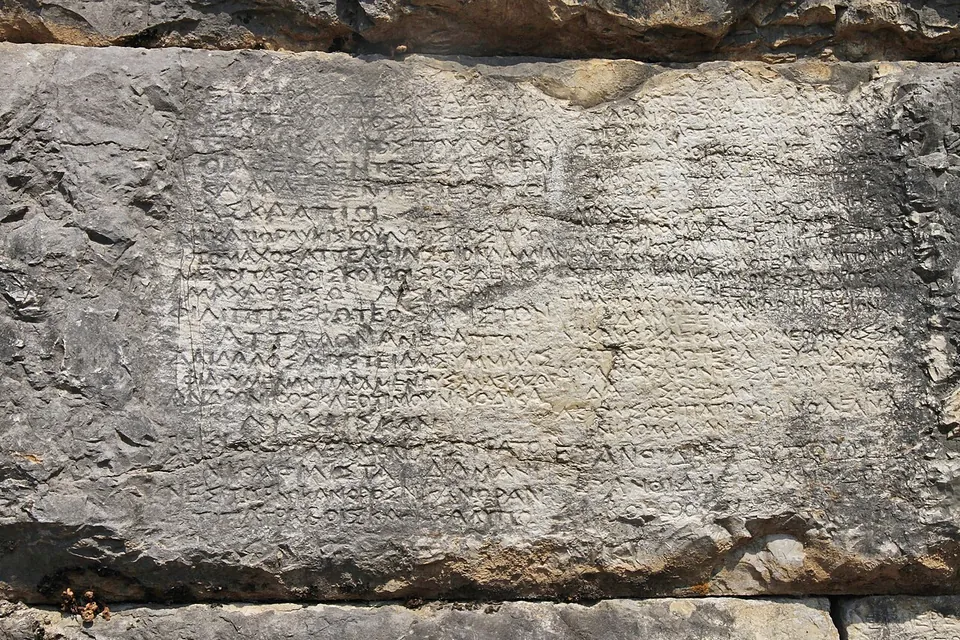
By the 4th century BC the Greek city had a theatre, a sanctuary of Asclepius and an agora. The theatre is known for the number of inscriptions carved on its stones, most of them recording the freeing of slaves (en.wikipedia). Under the Romans new buildings rose around the theatre and the temple of Asclepius (en.wikipedia).
The Roman town
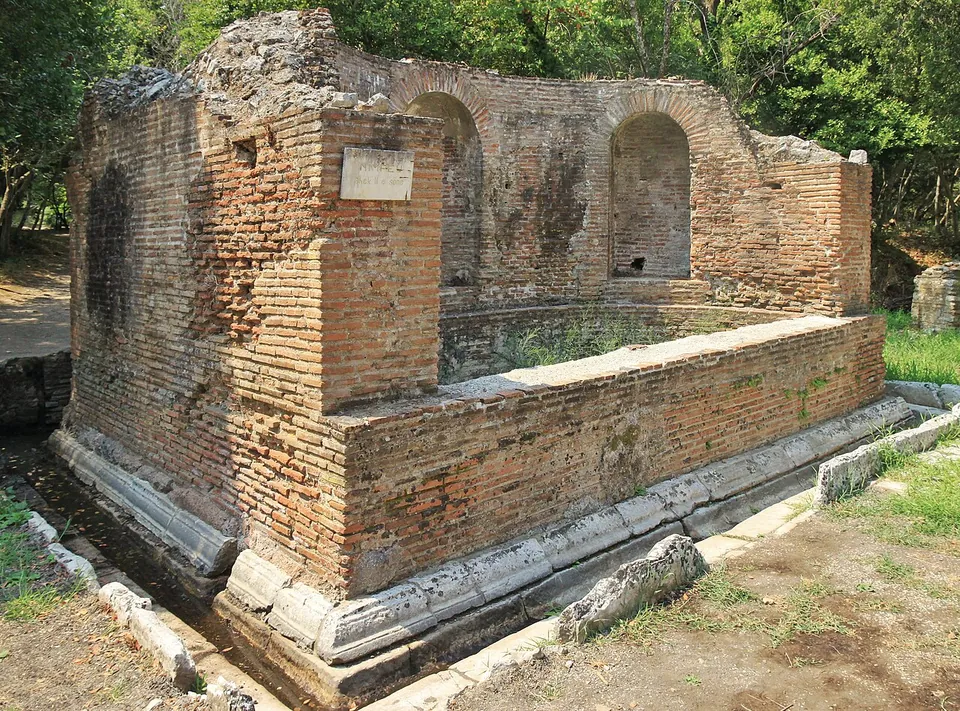
After Augustus settled veterans here, the city doubled in size, with an aqueduct, a Roman bath, houses, a forum and a nymphaeum, a monumental fountain (en.wikipedia). The Triconch Palace, the great house of a local notable, was built around 425 (en.wikipedia).
The baptistery
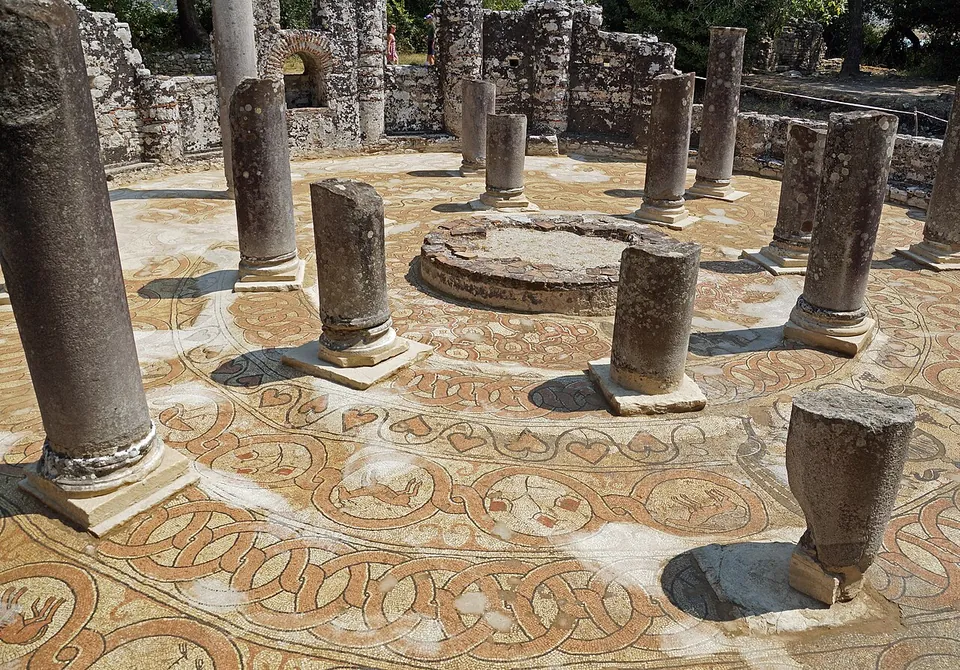
The 6th-century baptistery, 14.5 m across, was built inside part of a Roman bath. Two rings of eight Egyptian granite columns once held its roof around a cross-shaped font. Its mosaic floor, probably by craftsmen from Nicopolis, is considered the most complex of any surviving late antique baptistery in the Mediterranean, with peacocks by a wine vessel and stags at a fountain among bands of animals (en.wikipedia, Baptistery of Butrint).
The circuit of Greek walls, with its Lion Gate and Scaean Gate, and the great basilica of the 6th century complete the walk (en.wikipedia).
Is it worth the trip?
Yes — it is one of the most important ancient sites in Albania, where Greek, Roman and early Christian buildings stand together in woodland by a lagoon. It is a large site, so give it time, and note that parts of the lower city, including the theatre, can be under water.
Getting there
Butrint is about 14 km south of Sarandë, near the Greek border, on a road built for Khrushchev’s visit in 1959 (en.wikipedia). A bus stop marked “Bus to Saranda” and car parks are mapped about 250 m from the centre of the site, and a cable ferry crosses the Vivari Channel nearby (OpenStreetMap). From 1 April to 31 October the site opens 08.30–20.00, with last entry at 18.00; in winter it opens at 09.00 (the operator’s opening-hours page, as indexed on 26 September 2026). A ticket is needed, but its price could not be read from the operator’s own site; check at the counter.
Visiting details
- Opening hours
- 1 April to 31 October 08.30–20.00, last entry 18.00; from 1 November to 31 March it opens at 09.00 (the winter closing time was not readable).
- Tickets
- A ticket is required; the operator's price page could not be read, and no official figure is given here. The operator lists free-entry days, including 18 April (for Albanian citizens).
- Parking
- Free and other surface car parks about 250 m from the centre of the site (OSM way/288927598, fee=no; way/437134561).
Before you go
- Parts of the lower city, especially around the theatre and the forum, can sometimes be under water (en.wikipedia).
Hours and prices checked 26 September 2026 on the operator's own site. Confirm before travelling.
History
Bouthroton was a town of the Chaonians, a Greek people of Epirus, from at least the 7th century BC; Virgil made it the home of the Trojan seer Helenus, visited by Aeneas. It became a Roman protectorate in 228 BC. In 44 BC Caesar designated it a colony for his veterans; after Actium Augustus renewed the plan, and the town grew (en.wikipedia). An earthquake in the 3rd century AD levelled much of the forum and the suburbs, but the town survived as a port of the province of Old Epirus and the seat of a bishop, and its walls were rebuilt around the end of the 5th century (en.wikipedia). Italian archaeologists led by Luigi Maria Ugolini began modern excavations in 1928 (en.wikipedia).
More photographs


Nearby
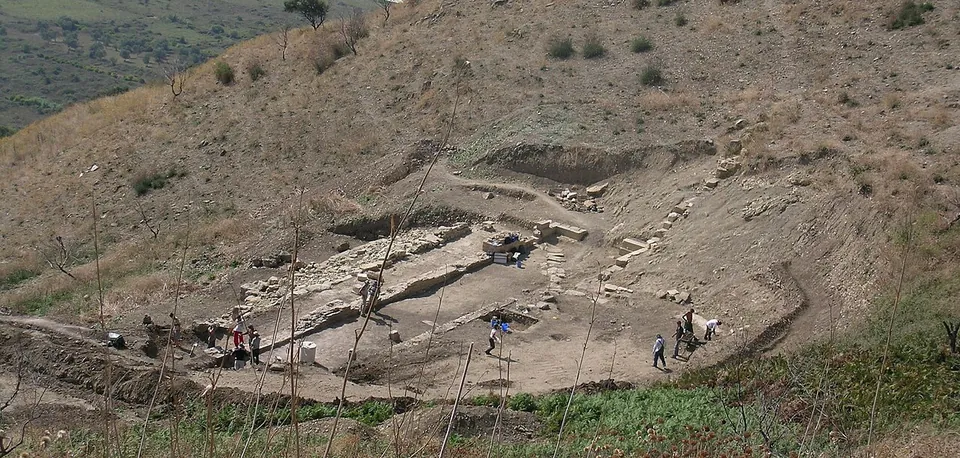
Photo: Giuseppe Lepore · CC BY-SA 3.0 · Commons

Straight-line distances.
Sources
Every fact on this page comes from the records below, each used under the licence noted.
| Source | Licence |
|---|---|
| Pleiades 530824 | CC BY |
| Wikidata Q188694 | CC0 |
| OpenStreetMap relation/9316413 | ODbL |
| Wikipedia (en) — Butrint | CC BY-SA 4.0 |
| Wikipedia (en) — Baptistery of Butrint | CC BY-SA 4.0 |
| Wikipedia (en) — Archaeological Museum of Butrint | CC BY-SA 4.0 |
| Wikipedia (en) — Butrint National Park | CC BY-SA 4.0 |
| Butrint National Park — Orari i Hapjes (the operator; opening hours) | licence not recorded |
| Butrint National Park — Cmimet e Biletave (the operator; tickets) | licence not recorded |