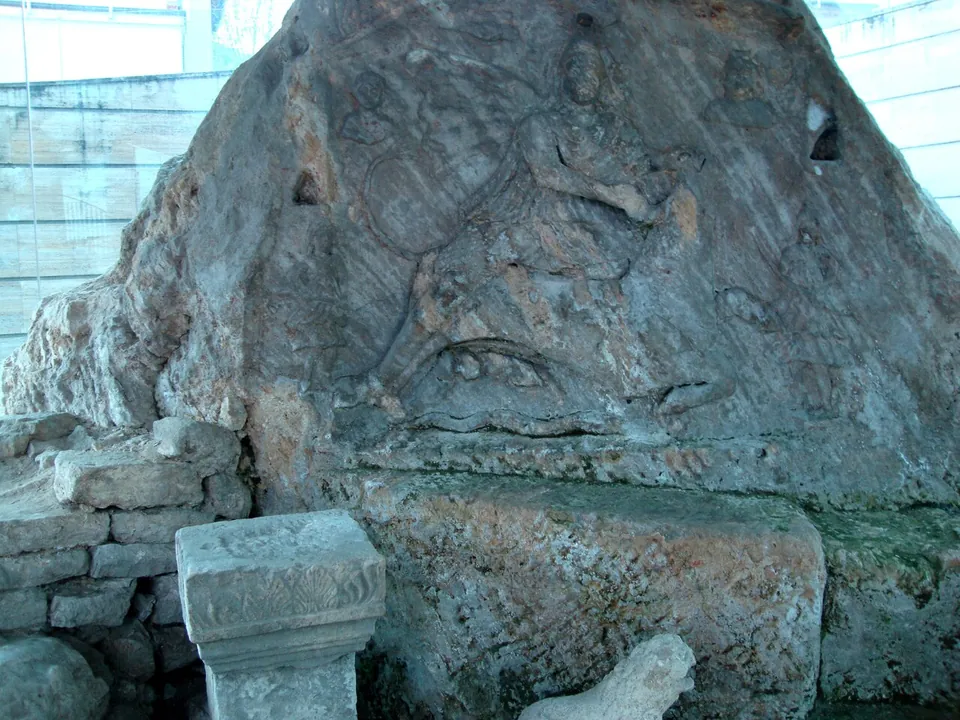
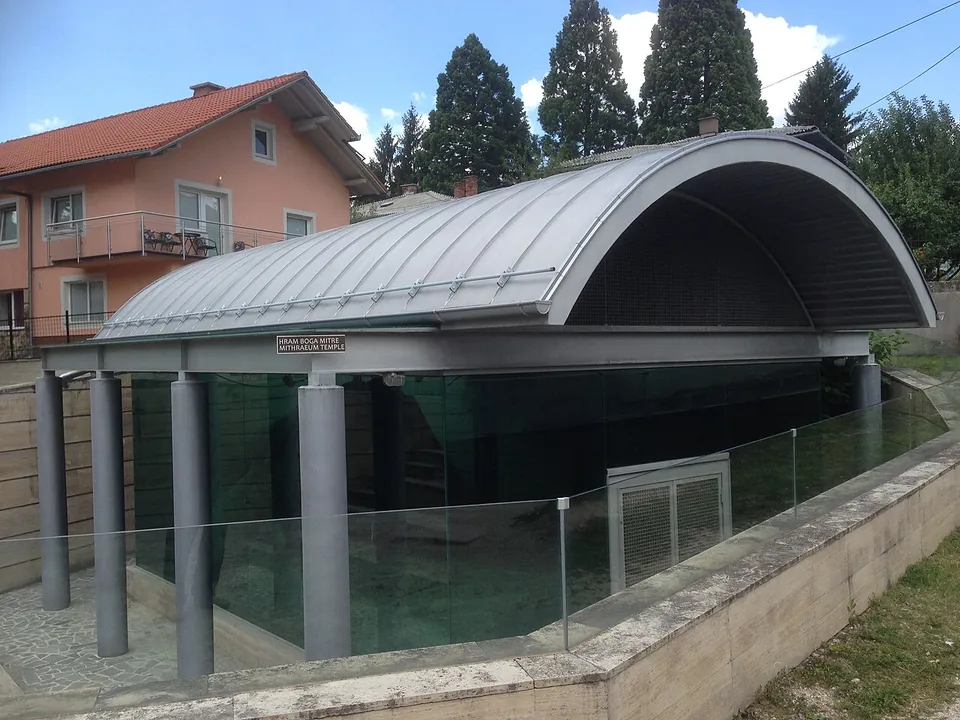


The Jajce Mithraeum is a small Roman shrine of the god Mithras in the town of Jajce, with its cult relief — Mithras killing the bull — carved into the living rock. It sits in a residential street under a glass shelter, so you can see it from outside at any hour.
What is there today
A single small room, about 7 m long, dug into the ground to feel like the cave the cult preferred. Its west wall, cut almost entirely from the rock, carries the central relief: Mithras in Persian dress, cloak flying, one knee on the bull, holding its muzzle with his left hand and driving a knife into it with his right, helped by a dog, a snake and a scorpion. The agency notes that it is the only relief in Bosnia and Herzegovina where the torch-bearers are shown and two free-standing Mithraic sculptures survive alongside. Water and tufa deposits brought most of the walls down; only the south and east walls can still be made out (the agency). Since 2012 a glass-walled steel shelter has protected the shrine and lets visitors look in without entering (en.wikipedia).
Is it worth the trip?
If you are visiting Jajce, yes — it costs almost nothing, and English Wikipedia counts it among the best-preserved mithraea in Europe. It is one small room, though; on its own it would not justify the journey, but Jajce, with its waterfall and fortress, gives you plenty of reasons to be there.
Getting there
The mithraeum is on Mitrasova street in Jajce (OpenStreetMap). You can see it through the glass at any time; to go inside, phone +387 30 658 268 or ask at the Ethnographic Museum near the Catacombs. The agency’s hours page, still headed for 2019, gives 08.00–20.00 from May to September, with visits by arrangement the rest of the year. A ticket is 2 KM (about €1), or 1 KM for children, students and pensioners from Bosnia and Herzegovina (JU Agencija Jajce, read 26 September 2026).
Visiting details
- Opening hours
- The shrine can be seen through the glass walls of its shelter at any time. To go inside, phone +387 30 658 268 or ask at the Ethnographic Museum in the old primary-school building near the Catacombs. The agency's hours page (still headed for 2019) lists 08.00–20.00 from 1 May to 30 September, with visits outside the season by arrangement.
- Tickets
- 2 KM (about €1); 1 KM (about €0.50) for children, pupils, students and pensioners from Bosnia and Herzegovina.
- Parking
- A car park is mapped about 100 m away (OpenStreetMap).
Hours and prices checked 26 September 2026 on the operator's own site. Confirm before travelling.
History
Mithraism spread through the Roman Empire from the East, carried by soldiers, officials, merchants and slaves (en.wikipedia). The Jajce shrine dates from the 3rd–4th century; English Wikipedia suggests it may go back to the 2nd century and was repaired in the early 4th. It was found by chance while a private house was being built — in 1931 according to English Wikipedia (and one agency post), at the beginning of the 20th century according to the agency’s monument page. The local antiquities society bought the site and built a stone shelter, repaired in 1952 and damaged in the war of the 1990s; it was replaced by the present glass shelter in 2012 (en.wikipedia). The mithraeum is a National Monument of Bosnia and Herzegovina.
Sources
Every fact on this page comes from the records below, each used under the licence noted.
| Source | Licence |
|---|---|
| Wikidata Q60745011 | CC0 |
| OpenStreetMap relation/19758696 | ODbL |
| Wikipedia (en) — Jajce Mithraeum | CC BY-SA 4.0 |
| JU Agencija Jajce — Mitrej (the operator) | licence not recorded |
| JU Agencija Jajce — Posjetite hram boga Mitre u Jajcu (prices) | licence not recorded |
| JU Agencija Jajce — working hours | licence not recorded |